Showing posts with label TEKS. Show all posts

Wednesday, October 23, 2024

Did I EARN it? What's next for service to literacy? The Vessel, Unity Learning Communities, and 12 Kids

It seems like a lot happens around the dinner table, coffee tables, and gatherings of folks.

The summer after third grade, I sat at the formica and chrome table to watch my mom teach my brother David how to read. The harvest gold refrigerator hummed nearby. The same one under which I used to hide my HILCOA vitamins.

By fifth grade, I was assigned a first grader to help learn to read. At the antique dining room table we bought from an estate sale from down the street, Mom helped me create manipulatives, handwriting paper, and flash cards from a book called Recipe for Reading. I still have the book...tattered and faded. 

During college, I heard a sermon on Romans 1 after the Lord's Supper Table. Reprobate minds and stuff. I remember thinking about what this meant for reading and reasoning. As I pondered, all the ideas were the same ones we saw in Figure 19 many years later and all the things in the Comprehension Strand beginning in 2019. Comprehension became a lifetime obsession. 

Doneice Ray allowed me to teach a first grade class as a long term sub when I graduated in '91. Wow. What an experience. Did I really know how to teach a person how to read? Did I even know about the Guided Reading table? Nope. The next semester, I was honored to teach for her in fifth grade. I stayed long enough to have those former first graders in my fifth grade class. By that time, I was figuring out a few things. 

Thirty three years later sitting at the granite bartop next to stainless steel appliances that don't last 10 years, I'm still figuring things out and the search continues for supporting comprehension in all readers and thinkers. 

Since retirement...I've been struggling. There's this scene at the end of Saving Private Ryan that summarizes my thoughts. Have I been and done what I've been gifted and charged to be? Have I earned it? 

And then this summer... Tremaine Brown, Jacob Breeden, and I put our heads together on a project over a piece of brown butcher paper in the dining room at Shi Lee's Soul Food. You see, Tremaine tries to make The Heights a better place for his daughter and all those around him. He's fed people so their tables and tummies are full. He's made sure they have clothes. He makes sure they have school supplies. He makes sure they have fun at holidays. But how could he help them with literacy? And we all know that success in school is complicated. Lots of reasons kids and teachers struggle. With the Vessel and Unity Learning Communities, we want to tackle all the barriers to literacy. 

In January, we'll begin with 12 kids. 5th and 6th graders that struggle with reading and writing. A counselor will lead a group of four teachers - three kids per adult. And a "grandma" figure will be the mentor for all of them. The community at the Warford will partner with us. 

As students of AISD, they've had all the literacy interventions. Powerful initial instruction and remediation. But yet, there are those that still struggle and aren't qualified for services like special education or emerging bilingual support. And there are those that have struggles related to society and living life in this century. We'll dig into those issues together, solving and supporting the struggles together. 

Honestly, it's a giant experiment. The Amarillo Area Foundation has funded a portion of what we need to begin...and we are honored by their investment in our children's future. This month and the next, we are meeting with teachers and counselors to collaborate on a set of challenges, processes, and key vocabulary and theoretical underpinnings for our approach. In January, we'll begin meeting with kids...thought partners and co-creators with them to cause their own success and growth. 

Along the way, we'll all be writing and documenting the process and outcomes...telling the story of what happens around these new tables.  Won't you join us? Learn more, connect, and join us here:  https://www.beblessedbythevessel.org/home 


(AI) Machine Scoring isn't the Problem: We are ALL Writing for Bots

I've been meaning to write about this for a while. But by now, many people have seen the scores and papers on STAAR exams. Very few essays have needed rescoring. Everything is going to be ok for both content scoring and mechanics. The scoring machine isn't the problem. Instructional relevance is. 

Yes - there are many things we still don't know about the language models used and how machine scoring actually works. That IS a problem but one of transparency from the agency, not for instructional implications.  

So let's think about how we can USE scoring realities to help make the process meaningful to those we serve. Here are five points that explain why we directly teach why machine scoring is relevant to daily life:  

1. All social media works with algorithms. You want to be seen and heard? You use terms and structures that the algorithm values. The scoring machine is looking for key terms from the text and prompt. 

2. Things like Netflix and Youtube give you content based on your behaviors. What you do changes what you are presented. You want to understand how to do the same for readers - even machines? Learn how to respond to reader needs with your text. 

3. Search engines work on what is promoted and searched and clicked frequently. Want a high score? Write what the rubric promotes and seeks. Want a high score? Use what's in the source text that fits the prompt. Scoring works like a giant Family Feud. Other students have already responded to this prompt with the source text and answer. The scoring machine "surveyed" a BUNCH of student essays and knows what most writers said and how the people scored their responses. Comprehend the text and the prompt. Use the text stuff in the written response, summarize how it fits into the text, and say in original thoughts about the connection to the ideas in the prompt. 

4. Search engines use key words to scan content and then matches those terms relevant to user's search terms. Want to be "seen" by the engine? Use terms that match what people want to see. For example, I've been writing for Sirius Education Solutions about thinking and reasoning in a project called Page to Pixel. There's a guy who reads over my stuff, restructures WHERE certain terms appear in the text, adds terms throughout, and chooses special search terms to embed in the code. I have no idea how the code works, but I can see that the key stuff goes in the intro, key connections to the topic are spread in each portion of the headings and body text, and the key stuff also goes into the conclusion. Sound familiar? We trace meaning and coherence through word choice and how we connect our topics through organizational structure. So, want a high score? Use key terms from the prompt and text in the intro and conclusion. Thread those ideas through each body paragraph with text that shares the same ideas/synonyms/textual context. The guy who edits my work for this puts these terms in bold so I can see how they thread through the text. I can see the connection and repetition of concepts through the entire text. 

5. Companies use machine scoring to preview resumes, cover letters, and communications. Priorities are given to text that includes what the company is looking for in the match of personnel to the job description and company goals. Understanding machine scoring is intensely personal and relevant to all those who are seeking employment. 

Machine scoring isn't new. Digital evaluation going on in the background of almost everything we do and see. And teaching without including explicit lessons on the relevance of these scoring machines isn't in the TEKS, but we'd be remiss if we didn't address the reality directly. 


Monday, November 6, 2023

Resource for SCR Scoring Guide for ALL Grades and Content

    TEA is a huge entity. If you could hear my accent, huge would have several syllables for emphasis. Size is the only reason I can figure out that some people get information and others don't. The people involved there do the best they can to balance security, permissions, and other stuff - but it's frustrating. Just today, I saw a post that someone didn't know that 3rd graders could be assessed with an argumentative prompt on any kind of genre of reading. 

    Texas Council for the Social Studies had a conference in October of 2023. Jo Ann Bilderback and Carmen Trejo presented for West Ed and TEA. (Someone who knows the connections can explain that to me sometime.) The resources associated with the session were created in February of 2023. Looks like the session was also offered in Region 14 at some time as well. Winter. 

    And now it's November. Next month our high school retesters will be taking the exam again. We need (and needed) this information. And it looks like great stuff! Why are we finding out about this stuff on accident? Why are only certain folks getting access? What am I missing? I try to be on top of things and to study, research, and attend sessions. What should we all do to have timely access to critical information? 

    I looked online where TEA posts recent presentations. Can't find it anywhere. So here it is: 

SCR Training from the TCSS conference

General Session Slides

RLA Content Slides

Science Content Slides

SS Content Slides

RLA Annotated Docs 

Science Annotated Docs

SS Annotated Docs

Now the question: Is there something out there about ECR that would help us? 

Another training from September.


Sunday, October 29, 2023

Hybrid/AI Scoring: Mechanics and Implications for Instruction


TEA kind of announced that AI is scoring stuff for ECR and SCR when they offered the testing administrator training this month. Ok. So we found out about it in a backhanded way. Moving on. 

My little rescue dog, Joy, is trained well. For one trick only: Be cute. Then she sits. Like Joy, the AI scoring machine will do exactly what it is trained to do, regardless of what we call it. For ECR/SCR on STAAR, the scoring will do exactly what it says it will do. 

We are going to be ok. It's time. We already have the technology to hear, transcribe, and interpret English vocabulary and syntax. Phones, text messages, emails, docs, etc. It's working pretty well. (I remember when Dragon Dictation started. Didn't work too well. But it learned and got better.) 

A friend of mine saw the video I posted on facebook about this: 

Hi😊I just came across your video you posted after meeting with your favorite English teachers. I’m not savvy to all the things your referencing in the video, but I will say…if AI allows the teachers a way to grade the students essays, I’m all for it. I would love to have all those HOURS back with my mom, my favorite English teacher. It was just our normal at the time…but looking back, she spent so much precious personal time at home “grading papers” when I was growing up.
❤️


Wow. That kind of hurt. And, we know that marking papers is actually a waste of time. See my dissertation. And I can't tell you how many hours I wasted in carrying those bags of papers home. 

So the implications for instruction are: 

1. Make sure teachers and students have access to technology that can "score" and grade papers for mechanics. Even if it costs money. This should be provided by TEA if they are using it to score. Assessment must match instruction. AI scoring resources are now instructional materials. 

2. Stop editing (grading) papers for writers. Don't do something a computer can do. 

Now - our next treat is going to be what all of this means for scoring content. More on that next. 


Thursday, February 10, 2022

Writing to Reading in 2023 STAAR

Writing to Reading

Caution: This year, 2022, is NOT the time to be teaching this for test prep. It's time to wait and see what the data says and final decisions by TEA. Now is the time to think, reflect, and develop our own knowledge about reader response. 

In 2023, students will be writing extended constructed responses (multiple paragraphs) based on what they read, "writing to reading." In other words, students will be writing in response to what they are reading: "writing in response to reading." 

This means that students will not be receiving a prompt that asks them to write an informational or argumentative essay. It means that they will be writing using informational or argumentative techniques to respond to a prompt about a text they have read. (Decisions have not yet been made on what genres will be assessed for each grade. Decisions have yet been made if the genres will be different each year. Decisions have not been made if the genres will be announced before the test.) As you know, all genres listed in the TEKS are available for assessment purposes. I can't see how they'd ever ask kids to write poetry or drama, but I do think we could see them writing in response to those genres. My opinion only. 

Caution: Just because students will not be asked to write from an informational or argumentative prompt, it does not mean that students should not be asked to write them in class. Just because it isn't assessed doesn't mean that we shouldn't be doing it. 

Hypothetical Examples

For example, in third grade, students learn about argumentative texts (9E). They also learn to distinguish facts from opinions in (9Ei). Students may (remember - the jury and field test data are still out) be asked to read a passage and answer a prompt explaining their opinion about something in the text. Their opinion becomes their claim (9Ei). Then students must use facts and details (9Eii) to support their claim. Students take a point of view and attitude (9Eiii) and pull support from the reading to justify their claim. 

4th grade students may read a personal narrative or story and be asked to write an informational essay comparing and contrasting the characteristics or actions of two characters. 

Students may read a paired passage about a topic and be asked to write a problem-solution response to the information presented in the article. 

The prompts are carefully designed with the information in the passage to ensure that students know the expectations to pull from the prompt and structure their writing response appropriately. We will know more about this after field testing. 

Why is persuasive still on the blueprint? What will we be writing in 2022? And my other random confusions about STAAR

What Genres will we Read?      

When the blueprints came out for STAAR, I was SO confused. I guess I was a bit dense, but I couldn't understand how persuasive genres were still assessable on STAAR. After several back and forth conversations, trying to explain my confusion, Chelaine Marrion and Valerie Pannell finally penetrated my skull with wisdom about what this means. 

Here's what Chelaine said - she makes it very clear: 

Students can be and are exposed to multiple genres of text in the classroom. Teachers are continuing to have students read persuasive and literary nonfiction (also no longer mentioned in the TEKS) texts. Those genres still exist. The difference is that there are no SEs in the TEKS that specifically address the characteristics of persuasive or literary nonfiction texts. Therefore, students will not be asked questions on STAAR that ask for their knowledge of the characteristics specific to those genres. There is nothing that prohibits a student from simply reading a literary nonfiction text and being asked vocabulary questions, inference questions, author’s purpose of including photograph questions, or text evidence questions, etc.. As noted, teachers across the state overwhelmingly requested these genres still be available to students.

And, because their customer service is so prompt, Chelaine asked Valerie to give me a phone call. I met Valerie during a TEKS guide evaluation session and came to admire her reasoning there. As we talked, I felt more and more confident in how persuasive will be addressed. Valerie explained that they are being very careful about text selections. Guidance to folks writing the questions for the passages explains that a variety of unique items should be crafted for passages. For instance, it would not be appropriate to develop six inference questions or four vocabulary questions. They don't want questions to "overlap." This is what we usually see with passages - the questions assess many different SE's. Since there are few TEKS that can be aligned to persuasive and literary nonfiction, they are being very careful about the quality of these passages and the variety of questions. I think we can all feel confident about that decision. 

What Genres will English I and II Write this Spring (2022)? 

As we talked, I had to add in another question. What genre will students this spring be writing in? English I will be writing expository. English II will be writing persuasive. Nothing has changed. It will not be until 2023 that we see the full switch to informational and argument. 

(We talked some more about item development for the new constructed response. I'll write about that later. We have to remember that all of those decisions are made after the field test data comes back in. And we want decisions to be made on data, right?) 

ASK them for Clarification

Valerie and Chelaine are always so appreciative of questions. They want us to ask when we hear things that don't quite sound right to us. People are already writing test prep materials and are doing workshops about the test redesign. Ultimately, it is TEA's interpretation of the standards that we should follow. If you go to a training and hear something that sounds wonky to you, look at TEA's presentations on video and ppt's that communicate the reality. Look at the released item types. And if it still doesn't make sense, it is better to call and ask the experts at TEA than following someone else. They would rather talk to you personally than have you believe things that are not true. 


Tuesday, July 6, 2021

Writing Like an Insider: Identifying as a Scholar

This morning, Dr. Lesley addressed the Llano Estacado Writing Alliance about Joining a Discourse Community as a Scholarly Writer. While that floats my boat personally, her ideas made me think about the writers I will encounter in the fall. Here are some ideas that I want to preserve and communicate. 

  • Teachers of writing should write. I will be finding my voice as a writer. This will feed my instruction and support for students and teachers. 
  • Writing Fluency is more complex than reading fluency. (Lesley, 2021 presentation)

 Hmmm. Here's the definition that Dr. Lesley shared with us:

Writing Fluency: The ability to produce written language rapidly, appropriately, cognitively, and coherently (Latif, 2013)

Students need to become aware of the components of their writing fluency. Our instructional activities should be explicit about the goals and the ways in which we achieve writing fluency. We want our students to begin writing after diffusing the prompt or assignment, not from a disjointed stream of consciousness, but from a capacity that considers deep meaning and the genre characteristics and conventions that will accurately and effectively deliver the message to their audience. They need to know how to get that kind of writing fluency going automatically. 

  • Each writing even it a unique rhetorical event (Lesley, 2021 presentation).  

That's why it feels like you are starting over each time. That's why there is no formula. The rhetorical situation will always be different. Do we let kids know that this is true for everyone and every writing task? Do they know the struggle is normal and they are not alone? 

  • Writing is inquiry (Lesley, 2021 presentation).  

YAAAAS. It is always new. We are always rethinking and rewriting - learning all the while. Writing is thinking made visible in ink, graphite, or binary code. 

  • We learn to write and investigate our thinking through writing (Lesley, 2021 presentation).

How do you learn to do something? You get in there and do it. You learn about the something and a lot more about yourself. 

  •  Scholarly Voice: scholarly voice is about contextualizing the research, situating the study and the researcher personally (Lesley, 2021 presentation). 

We write so they can see our face and hear our voice and know our personality. The way we write exposes our thinking and our personality. Do the kids know it doesn't have to be stilted or boring? 

  • Introspective writing helps students move into a creative space where they are free to play with language, capture descriptive details, elaborate on the seemingly insignificant and juxtapose disparate ideas against each other. Introspection allows the writer's self to be present in all facets of the writing act (Lesley, in press). 

Wow. That's writing like an insider. So here's my questions to guide instruction in the fall. 

1. How do we help kids write like an insider for particular genres if we don't teach them how to read a text for how it is structured and the techniques the writer is using? How do we teach them to dissect a text not just for comprehension, but for CREATION for their own purposes? I need to create lessons and opportunities for this work...to go beyond comprehension to CRAFT. Our Texas ELAR standards have two Knowledge and Skills statements for craft. One is to analyze craft. The other is to USE craft for their own meaningful products and performances. 

2. How do we help kids write like an insider if they never read the kind of stuff we are asking them to write? We need more mentor texts that kids have written. 


Thursday, July 1, 2021

A Convo about Getting Results: How we Get to the Answer Matters Most

Cheryl texted me her STAAR results. We’d been talking about the previous post. 


Cheryl: English I - 66% Approaches, 50% Meets, 12% Masters

English II - 70% Approaches, 57% Meets, 11% Masters

Our. Kids. KILLED. It!!!! I believe for English I students (before retests and including retested students in

the spring it was 79% Approaches, 62% Meets, 12% Masters. Only my kids, no re-testers:

82% Approaches, 64% Meets, 14% Masters. And I don’t know the final tally with re-testers that may

have passed. 2021 was my first administration at this campus since we didn’t admin in 2020.
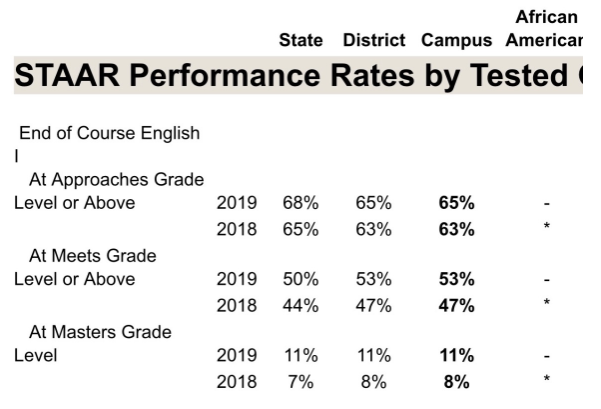


Shona - So this means…


Before Cheryl’s Strategies

Cheryl’s Class

Change

2019 Approaches

State        68%
District     65%

Campus   65%


2019 Meets

State        50%
District     53%

Campus   53%


2019 Masters

State       11%
District    11%

Campus  11% 

2021 Approaches

State               66%

District            

Cheryl’s Class 82%


2021 Meets

State               50%

District             

Cheryl’s Class 64%


2021 Masters

State                12%

District              

Cheryl’s Class  14%


20% gain


14% gain


2% gain


Shona: Holy cow, Cheryl! What did you do during COVID to get such results?

I know that I always rely on you to further the prototypes that we design based on the needs

we are seeing. But I didn’t expect such a gain the first year. 


Cheryl: That’s a great question. This year was really the culmination of things I’ve learned over the last

5 years (mostly from you!) that I was finally able to put into practice all at once.

Some foundational things I think are a starting point for this conversation: 

  • Understanding the new TEKS helped me understand the depth at which our students needed to understand texts. And the types of texts they needed to read--and how they should be constantly making connections within and across texts of various genres. Even though we changed topics many times in the class, students often commented that our class seemed like one giant thematic yarn ball--and I think any good reader/ writer probably feels the same way about everything they read and write. That was a sign I was on the right path. 

  • Reading/ Writing/ Speaking/ Listening/ Thinking as a constant cycle in our class. We were always doing all 5 around a text, around our own writing, around sharing, around talking as a starting place for all of the above. 

These two pieces became the foundation for everything else. I think some people reading this probably

want to know what textbook we used or what workshop I went to that made me successful in 6 hours

or less, but this is a culture we have to create in our classes, and it’s not easy. We (usually) have to

fight trends in instruction that may not have encouraged real thinking and fight the idea that there is

some sort of “formula” to the right answer or the best essay. It’s an organic process.

And if a teacher isn’t committed to that type of paradigm shift (s)he won’t be successful. 


Shona: Wow. That’s a lot to unpack. I have always felt that you absorb things over time and then put

them back together in a way that works for your teaching style and the kids in front of you that year.

I see that the two major things you mention are about your understanding of the TEKS and your use of

the domains of literacy. A third might be missed - the paradigm shift you experienced to a more

constructivist approach to instruction in cognitive literacy processes as opposed to a text based

approach that is in our instructional historical dna. LOL. 


Cheryl: Yes, I think what you mention is a huge key. It took me a long while to realize this,

but it doesn’t matter WHAT we read, it matters what we do with what we read.

Please know that of course it matters what we read, but too many people are focused on teaching texts

and not focused at all on how to connect them or what to do with them. Of course I had a plan,

I had things I wanted my students to read for certain reasons or to connect in certain ways,

but some of my plans happened, and some of them didn’t. Sometimes I would scrap something

so we could spend more time on another thing or so we could add in something related to what

they wanted to know more about. We can talk about “student centered classrooms” all day long,

but unless we are ready to follow their lead in interests, pacing, and unpacking, we aren’t going to

see them engage to the level of depth required in these new standards. AGAIN: Of course I had texts

and tasks planned, and NO, they didn’t always like it (at first), but as we built a culture and classroom

together, we could move some things more into their lane. 


Shona: So, really, I’m curious about what you taught about diffusing the passages that matched this

organic view of instruction and still caused gains for the students. I know you were using the fact tracker...but how did you roll it out, adapt it. What sense of it did the kids take on? How did their take change the process as you taught it? 


Cheryl: I start the year with a philosophy that has really helped me understand texts more deeply and we roll

out baby steps. I don’t get to the full fact tracker until the 2nd semester because in the first semester,

our focus is on developing the new paradigm. 


In the first two weeks of the semester, I introduce 2 concepts: 

  • Everything (and I do mean EVERYTHING) is an argument. 

  • & Some things are Story 

  • (and all the genres can flow from here). 


As we look at everything being an argument, I introduce the main elements of argument and we look for those in various genres. We quickly boil this down to “what’s the point?” or “what are they getting at?” --in genres like poetry, drama, fiction, etc. this often presents as one or more themes. Although it takes them a while to get good at it, I’ve taught them probably the most difficult skill we’ll work on all year and a process to identify it from Day 1. 


Shona: This makes a lot of sense to me. Some of the questions I use with this part are: What’s it about? Why does it matter? Or when I’m feeling snarky, I ask: who cares? 


Cheryl: When we get to Story, we look at the elements of a story: Characters, setting, conflict, plot, resolution.

We start with basically a 5th-8th grade review of things they should have learned along the way

(this builds confidence) (and it only takes about 1 class period), then I give them a text set that

includes various genres. (Song, poetry, drama, news, short story, etc.) and have them work with a

partner or group to tell whether each is a story and why/ or why not. (They are all stories.)


Shona: Aw, I see what you are doing here. Nice.


Cheryl:  (Not every poem is a story, but the ones I include, are). As a class, we go through the works

and identify the elements of story in each one and at the end  of each piece we ask ourselves two

questions that we will carry through the entire year: 

  1. What happened? (plot, or your quick clue this isn’t a story) 

  2. What’s the point? (theme, claim, main idea THERE IS ALWAYS AT LEAST ONE POINT). 

This hits on our TEKS in a million ways, but one of the best ways is that this is a self-monitoring tool.

If a student can’t answer these two questions, they need to re-read and try again. 


Shona: YES. We use summarization and theme finding as a tool to monitor our comprehension

instead of a product to be evaluated. Changes how they use the strategy to become assessment

capable and aware of their own cognition/comprehension. That’s why Learning on Display focuses on

reasoning THROUGH reading and writing. Reading and Writing are the tools for our thoughts and

response to ideas. 


Cheryl: Note here, that their answers don’t have to be correct here. In fact, at first, they are usually wildly wrong.

After we read a text and answer these questions, I ALWAYS have them stop and pair/ share.

This allows them to correct or confirm their ideas (OMG, LOOK→ another TEKS!) 


Shona: I’m impressed with this allowance to be wrong. Too often we are the ones that identify that for kids.

Let’s let them marinate in error and wade out of it through their reading and writing reasoning processes.

Until we are comfortable with allowing them to identify their own errors, we are doing the thinking work for

them when we tell them that they are wrong. And we steal the joy of discovering what is correct. 


Cheryl: You are absolutely right. But this, too, can be a huge struggle to build into the course, culturally.

My students have often been conditioned to believe they MUST have the right answer and at first find

themselves too paralyzed to provide any response at all or completely obsessed with being right--

which prevents them from learning at all. Believe it or not, at least initially, I generally have the best

progress and growth with my lowest level students. They are usually so fed up with school at all that

they are the most willing to throw anything out there. My honors students are usually most frustrated

with this process. 


Shona: YAAAAS. It was HARD to sit by Micah and agree with all his incorrect reasoning.

But it was a critical moment for HIM. I took a stance as a collaborator and thought-partner

with him instead of the corrector. This allowed me to ask...wait a minute...

I thought we proved all those wrong! Why isn’t D correct? This stance preserved his dignity,

but also didn’t stop his thinking. He was the one that ultimately decided how to revise his thinking

and reject what he initially thought was right. 


Cheryl: Yes. My students have to learn early on not to mark any answer I agree with! Haha!

I’ll agree with whatever they say, no matter what! They have to be bold enough to think it out and

question each other’s thoughts. 


Shona: I found that in my research as well. They have to be willing to reject the teacher’s ideas and go

forward with their own ideas and reasoning processes. It’s our job to allow it. 


Cheryl: And model it. I do a lot of modeling and thinking aloud. I also sometimes have to have a

conversation with my classes (for the benefit of my students who are quick to answer everything).

This is about the process. Yes, the answer matters, but how we get to the answer matters most


Shona: I had to go back and bold that statement. 


Cheryl: And while some people have these internal conversations and debates in their heads in a

matter of seconds-- many, if not most, of my students need to hear these conversations so they can

develop these models for themselves. And, truly, this takes time. It’s a repetitive process that we

build into EVERY text we read. As the process becomes quicker and I can see my students are getting it,

I’ll layer in the next steps to build depth. 


Shona: Agreed. That’s why I felt like I needed to model the convo in the previous blog post.

I don’t think the TEKS really are specific in how we reject answers we originally thought were right.

That stuff still needs to be taught - the thinking of how to make an inference and self-monitor to make

sure it’s right. The questions on STAAR really are aligned to TEKS, but I’m not sure we are really

teaching the implied THINKING TEKS that allow us to show mastery of the individual TEKS.

It’s like a hidden curriculum that really exposes the rigor more than anything I have seen out there.

We need to do more thinking about HOW we THINK. 


Cheryl: That leads into how I layer depth\ into our reading and writing. We have to teach our students how

to think about the texts. From here we rebuild their ideas of annotation. Most of my freshmen come

to be thinking they have to summarize every paragraph… but annotation is a lot more than that.

And we don’t always annotate everything. It’s a tool to help our thinking.

We use the summarization annotation to paraphrase or summarize difficult (usually non-fiction) texts.

Sometimes our annotations are questions (because good readers ask questions!)

Sometimes we write or label what we notice, we write our understanding, make predictions,

make notes of our confusion to bring to the discussion later. 


Shona: Once that annotation and internal talk become automatic, I let my kids let go of the annotations and

trackers until they need them for a point of struggle. 


Cheryl: Answering our two questions (WH, WTP?) and using annotations as a tool are the first ways

I build writing into the course. We read, and as we read, we cycle through these small writings about

our texts. 


Bonus Lesson Plans Cheryl and Shona Suggest: Using tools like the C3WP from the National Writing Project, we also learn to effectively identify and use

text evidence. https://sites.google.com/nwp.org/c3wp/home

Cheryl: I also love to teach Gretchen Bernabei’s kernel essays and tie some of the “Text Structures From the Masters” into our units. This really helps the students see text structure

and tie it to purpose. (Not PIE--haha, another soapbox I’ve picked up from you!) 


Shona: Yeah - don’t get me started on PIE. I think we’ve given folks enough to think about today.

And you need to go fold the laundry and I need to go cook supper. :) 


Cheryl: Thank you for this. I absolutely enjoyed it. If you are reading this and don’t already know,

Shona is THE BEST. <3 


Shona: We are the best when we are thinking together. Love ya.