Thursday, July 1, 2021

A Convo about Getting Results: How we Get to the Answer Matters Most

Cheryl texted me her STAAR results. We’d been talking about the previous post. 


Cheryl: English I - 66% Approaches, 50% Meets, 12% Masters

English II - 70% Approaches, 57% Meets, 11% Masters

Our. Kids. KILLED. It!!!! I believe for English I students (before retests and including retested students in

the spring it was 79% Approaches, 62% Meets, 12% Masters. Only my kids, no re-testers:

82% Approaches, 64% Meets, 14% Masters. And I don’t know the final tally with re-testers that may

have passed. 2021 was my first administration at this campus since we didn’t admin in 2020.
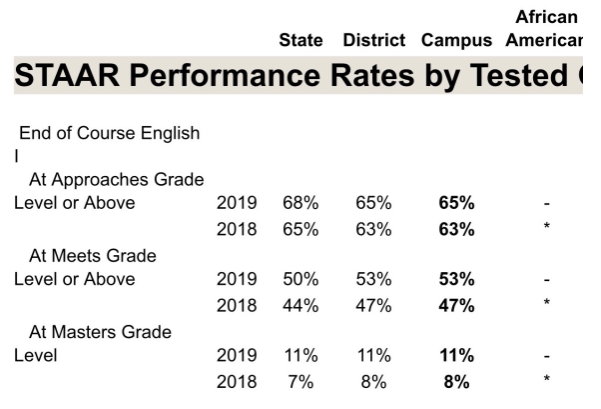


Shona - So this means…


Before Cheryl’s Strategies

Cheryl’s Class

Change

2019 Approaches

State        68%
District     65%

Campus   65%


2019 Meets

State        50%
District     53%

Campus   53%


2019 Masters

State       11%
District    11%

Campus  11% 

2021 Approaches

State               66%

District            

Cheryl’s Class 82%


2021 Meets

State               50%

District             

Cheryl’s Class 64%


2021 Masters

State                12%

District              

Cheryl’s Class  14%


20% gain


14% gain


2% gain


Shona: Holy cow, Cheryl! What did you do during COVID to get such results?

I know that I always rely on you to further the prototypes that we design based on the needs

we are seeing. But I didn’t expect such a gain the first year. 


Cheryl: That’s a great question. This year was really the culmination of things I’ve learned over the last

5 years (mostly from you!) that I was finally able to put into practice all at once.

Some foundational things I think are a starting point for this conversation: 

  • Understanding the new TEKS helped me understand the depth at which our students needed to understand texts. And the types of texts they needed to read--and how they should be constantly making connections within and across texts of various genres. Even though we changed topics many times in the class, students often commented that our class seemed like one giant thematic yarn ball--and I think any good reader/ writer probably feels the same way about everything they read and write. That was a sign I was on the right path. 

  • Reading/ Writing/ Speaking/ Listening/ Thinking as a constant cycle in our class. We were always doing all 5 around a text, around our own writing, around sharing, around talking as a starting place for all of the above. 

These two pieces became the foundation for everything else. I think some people reading this probably

want to know what textbook we used or what workshop I went to that made me successful in 6 hours

or less, but this is a culture we have to create in our classes, and it’s not easy. We (usually) have to

fight trends in instruction that may not have encouraged real thinking and fight the idea that there is

some sort of “formula” to the right answer or the best essay. It’s an organic process.

And if a teacher isn’t committed to that type of paradigm shift (s)he won’t be successful. 


Shona: Wow. That’s a lot to unpack. I have always felt that you absorb things over time and then put

them back together in a way that works for your teaching style and the kids in front of you that year.

I see that the two major things you mention are about your understanding of the TEKS and your use of

the domains of literacy. A third might be missed - the paradigm shift you experienced to a more

constructivist approach to instruction in cognitive literacy processes as opposed to a text based

approach that is in our instructional historical dna. LOL. 


Cheryl: Yes, I think what you mention is a huge key. It took me a long while to realize this,

but it doesn’t matter WHAT we read, it matters what we do with what we read.

Please know that of course it matters what we read, but too many people are focused on teaching texts

and not focused at all on how to connect them or what to do with them. Of course I had a plan,

I had things I wanted my students to read for certain reasons or to connect in certain ways,

but some of my plans happened, and some of them didn’t. Sometimes I would scrap something

so we could spend more time on another thing or so we could add in something related to what

they wanted to know more about. We can talk about “student centered classrooms” all day long,

but unless we are ready to follow their lead in interests, pacing, and unpacking, we aren’t going to

see them engage to the level of depth required in these new standards. AGAIN: Of course I had texts

and tasks planned, and NO, they didn’t always like it (at first), but as we built a culture and classroom

together, we could move some things more into their lane. 


Shona: So, really, I’m curious about what you taught about diffusing the passages that matched this

organic view of instruction and still caused gains for the students. I know you were using the fact tracker...but how did you roll it out, adapt it. What sense of it did the kids take on? How did their take change the process as you taught it? 


Cheryl: I start the year with a philosophy that has really helped me understand texts more deeply and we roll

out baby steps. I don’t get to the full fact tracker until the 2nd semester because in the first semester,

our focus is on developing the new paradigm. 


In the first two weeks of the semester, I introduce 2 concepts: 

  • Everything (and I do mean EVERYTHING) is an argument. 

  • & Some things are Story 

  • (and all the genres can flow from here). 


As we look at everything being an argument, I introduce the main elements of argument and we look for those in various genres. We quickly boil this down to “what’s the point?” or “what are they getting at?” --in genres like poetry, drama, fiction, etc. this often presents as one or more themes. Although it takes them a while to get good at it, I’ve taught them probably the most difficult skill we’ll work on all year and a process to identify it from Day 1. 


Shona: This makes a lot of sense to me. Some of the questions I use with this part are: What’s it about? Why does it matter? Or when I’m feeling snarky, I ask: who cares? 


Cheryl: When we get to Story, we look at the elements of a story: Characters, setting, conflict, plot, resolution.

We start with basically a 5th-8th grade review of things they should have learned along the way

(this builds confidence) (and it only takes about 1 class period), then I give them a text set that

includes various genres. (Song, poetry, drama, news, short story, etc.) and have them work with a

partner or group to tell whether each is a story and why/ or why not. (They are all stories.)


Shona: Aw, I see what you are doing here. Nice.


Cheryl:  (Not every poem is a story, but the ones I include, are). As a class, we go through the works

and identify the elements of story in each one and at the end  of each piece we ask ourselves two

questions that we will carry through the entire year: 

  1. What happened? (plot, or your quick clue this isn’t a story) 

  2. What’s the point? (theme, claim, main idea THERE IS ALWAYS AT LEAST ONE POINT). 

This hits on our TEKS in a million ways, but one of the best ways is that this is a self-monitoring tool.

If a student can’t answer these two questions, they need to re-read and try again. 


Shona: YES. We use summarization and theme finding as a tool to monitor our comprehension

instead of a product to be evaluated. Changes how they use the strategy to become assessment

capable and aware of their own cognition/comprehension. That’s why Learning on Display focuses on

reasoning THROUGH reading and writing. Reading and Writing are the tools for our thoughts and

response to ideas. 


Cheryl: Note here, that their answers don’t have to be correct here. In fact, at first, they are usually wildly wrong.

After we read a text and answer these questions, I ALWAYS have them stop and pair/ share.

This allows them to correct or confirm their ideas (OMG, LOOK→ another TEKS!) 


Shona: I’m impressed with this allowance to be wrong. Too often we are the ones that identify that for kids.

Let’s let them marinate in error and wade out of it through their reading and writing reasoning processes.

Until we are comfortable with allowing them to identify their own errors, we are doing the thinking work for

them when we tell them that they are wrong. And we steal the joy of discovering what is correct. 


Cheryl: You are absolutely right. But this, too, can be a huge struggle to build into the course, culturally.

My students have often been conditioned to believe they MUST have the right answer and at first find

themselves too paralyzed to provide any response at all or completely obsessed with being right--

which prevents them from learning at all. Believe it or not, at least initially, I generally have the best

progress and growth with my lowest level students. They are usually so fed up with school at all that

they are the most willing to throw anything out there. My honors students are usually most frustrated

with this process. 


Shona: YAAAAS. It was HARD to sit by Micah and agree with all his incorrect reasoning.

But it was a critical moment for HIM. I took a stance as a collaborator and thought-partner

with him instead of the corrector. This allowed me to ask...wait a minute...

I thought we proved all those wrong! Why isn’t D correct? This stance preserved his dignity,

but also didn’t stop his thinking. He was the one that ultimately decided how to revise his thinking

and reject what he initially thought was right. 


Cheryl: Yes. My students have to learn early on not to mark any answer I agree with! Haha!

I’ll agree with whatever they say, no matter what! They have to be bold enough to think it out and

question each other’s thoughts. 


Shona: I found that in my research as well. They have to be willing to reject the teacher’s ideas and go

forward with their own ideas and reasoning processes. It’s our job to allow it. 


Cheryl: And model it. I do a lot of modeling and thinking aloud. I also sometimes have to have a

conversation with my classes (for the benefit of my students who are quick to answer everything).

This is about the process. Yes, the answer matters, but how we get to the answer matters most. 


Shona: I had to go back and bold that statement. 


Cheryl: And while some people have these internal conversations and debates in their heads in a

matter of seconds-- many, if not most, of my students need to hear these conversations so they can

develop these models for themselves. And, truly, this takes time. It’s a repetitive process that we

build into EVERY text we read. As the process becomes quicker and I can see my students are getting it,

I’ll layer in the next steps to build depth. 


Shona: Agreed. That’s why I felt like I needed to model the convo in the previous blog post.

I don’t think the TEKS really are specific in how we reject answers we originally thought were right.

That stuff still needs to be taught - the thinking of how to make an inference and self-monitor to make

sure it’s right. The questions on STAAR really are aligned to TEKS, but I’m not sure we are really

teaching the implied THINKING TEKS that allow us to show mastery of the individual TEKS.

It’s like a hidden curriculum that really exposes the rigor more than anything I have seen out there.

We need to do more thinking about HOW we THINK. 


Cheryl: That leads into how I layer depth\ into our reading and writing. We have to teach our students how

to think about the texts. From here we rebuild their ideas of annotation. Most of my freshmen come

to be thinking they have to summarize every paragraph… but annotation is a lot more than that.

And we don’t always annotate everything. It’s a tool to help our thinking.

We use the summarization annotation to paraphrase or summarize difficult (usually non-fiction) texts.

Sometimes our annotations are questions (because good readers ask questions!)

Sometimes we write or label what we notice, we write our understanding, make predictions,

make notes of our confusion to bring to the discussion later. 


Shona: Once that annotation and internal talk become automatic, I let my kids let go of the annotations and

trackers until they need them for a point of struggle. 


Cheryl: Answering our two questions (WH, WTP?) and using annotations as a tool are the first ways

I build writing into the course. We read, and as we read, we cycle through these small writings about

our texts. 


Bonus Lesson Plans Cheryl and Shona Suggest: Using tools like the C3WP from the National Writing Project, we also learn to effectively identify and use

text evidence. https://sites.google.com/nwp.org/c3wp/home

Cheryl: I also love to teach Gretchen Bernabei’s kernel essays and tie some of the “Text Structures From the Masters” into our units. This really helps the students see text structure

and tie it to purpose. (Not PIE--haha, another soapbox I’ve picked up from you!) 


Shona: Yeah - don’t get me started on PIE. I think we’ve given folks enough to think about today.

And you need to go fold the laundry and I need to go cook supper. :) 


Cheryl: Thank you for this. I absolutely enjoyed it. If you are reading this and don’t already know,

Shona is THE BEST. <3 


Shona: We are the best when we are thinking together. Love ya. 

Wednesday, June 30, 2021

Time, Talent, and Treasure: Lessons Learned about ABC

 Each week, I will be donating one day of service to a local school district. I have been given so much and want to share in my blessings. Working in a district - where teachers have to make all the acronyms of public education meet the "rubber of the road" in the classroom - are different that the "theory" of best practices. There are so many adjustments you have to make in responding to how kids think all of that means as they do their work. 

Here's a simple report of what Micah taught me during STAAR bootcamp. The curls peeked out from his rose bucket hat as we sat together while he described his reasoning process in selecting an answer for a question. 


He reviewed A and the evidence to discount A. I didn't necessarily agree, but listened to his process as he shared his thinking. Same for B and C. Once he had removed those as possibilities, he immediately circled D as the correct answer without reading the stem. 

I asked, How do you know that is correct?

Micah: The others are wrong. 

Me: But why is D right? Do you know? 

Micah: Uhhhhh. 

Aha for me. The kids don't necessarily understand that one question is three questions. They don't know when their reasoning is off. 

Solution: I need to model a think aloud about a similar reasoning error. Here's my rough draft of the think aloud of the reasoning process. 


Lesson Title: Reasoning through ABCD multiple choice answers.

TEKS: Author's Purpose, Main Idea, Summary, Inference, Text Evidence, Argument

Objective: I can use reasoning strategies to determine author's purpose. I can evaluate all answer choices before selecting an answer. I can change my original thoughts after considering the collective evidence and lack of evidence to justify the correct answer. I understand that just because I have considered A, B, and C, that D is not automatically the right answer. 


Step one: I need to find the main words in the stem to guide my thinking. I'm going to underline 14 so I know where to look. I'm going to underline infer so that I know that I have to use the text evidence to make a decision. I'm going to highlight author to help me understand that I'm going to be thinking about the author's perspective or purpose and not mine or a character. 

Step two: Now I need to process the answer choices. I'm going to highlight the words to help me focus on the verb and the distinctive details. In "enjoys reading books by international authors," I'm focusing on enjoys reading because I need to look and see if the author enjoys reading. But that's not enough. The important detail here is "international authors," so I'll focus on that. I'll do the same with all three answer choices. Here's what my question looks like now.  


Notice how c is a choice that asks me to compare printed books to e-books. We have to look for those kinds of thinking charges as well. 

Step three: Now I am ready to process each question with each choice. 

A - Here's what I found in the paragraph. There are two international countries mentions. But it doesn't say that the author LIKES to read them, just that you find them in the LFL. So I think this one is wrong.
B - Here's what I found in the paragraph. 

The passage discusses finding something depending on what neighbor's like. But that's not really the same thing as discovery is it? I think this one is wrong too. 

C - So this is the comparison of topics between ebooks and printed books. The text mentions topics for printed books, but doesn't say anything about the topics on the e-books. This has to be wrong. 

Now, I'm tempted to to say that D is the right answer because I've already done a lot of work. But that would be a mistake. I'm not totally sure that my decisions were the right ones. I know that often there is a good answer and a best answer. I won't know until I see that D is best or wrong. If it's obvious that I am wrong, I've made a mistake in my reasoning. I still have to look at D even though I don't want to. 

D - I'm supposed to look for limitations of a free library. So I'll look at each sentence and see if it is talking about limitations of a free library. 

"Though they owe their spread largely to the internet" that's a concession about how they spread, but really is not a connotation about something that is lacking. 

"Little Free Libraries serve as an antidote to a world of Kindle downloads and data driven algorithms" So I have to translate this into words I know. What the heck is an antidote? After looking it up, I can rephrase the sentence to see if it matches limitations. "LFL are a solution to a disease of ebooks and technology." Solutions to a disease has a positive connotation. That can't be a limitation. So D is wrong. 

Step Four: That means I need to re-see my previous thinking. ABC might be right. I'm reminded that the Title helps a lot with Author's Purpose: "The Low Tech Appeal of Little Free Libraries." So this author priorities/favors printed books because they are low tech. So his focus isn't really about liking international stuff. I can disregard A. 

As for B, the line in the text that uses antidote to Kindles matches the contrast with the ebooks. He also talks about "refreshingly human" and being "physical." That fits with the title in being better than high tech. Serendipity - had to look that up. It's a happy chance. That fits with "appreciates the opportunity" in the answer choice language. Now I just need to find a match for "discovery". I'm wondering if "neighbor's taste" and "dictates what you find" match the serendipity because you just don't know what you will find. The topics are a surprise. B is sounding like a better answer than I originally thought. 

Now I just need to make sure to reconsider c. There is just no evidence that the topics are the SAME for both ebooks and printed ones. C is still wrong. 

So, after further reflection and testing my original reasoning with text evidence that supports or refutes the answer choices collectively, B is the best answer.

Bottom line learning: I cannot rely on making a decision about the right answer before I consider all answer choices in light of the text evidence about all the choices. And I have to be willing to change what I originally thought. 

*Note that if students were using the fact tracker and understood that this passage was argumentative in nature, they would have noticed that this paragraph is a major reason that LFL are superior to ebooks. It is a critical paragraph that supports the thesis implied in the title low tech appeal and in the thesis statement in the first sentence:  The “take a book, return a book” boxes are catching on even in places where Kindles and brick-and-mortar libraries abound.  We noticed that kids using their strategies did MUCH better on inference questions than those who did not. I'll explain why in future posts. 


Thursday, May 6, 2021

Back to Normal Nightmares

Who would ever think that back to normal would be a nightmare? Let's run away from normal. It wasn't working. Pandemication in education just revealed stuff that was already wrong. The virus simply made it visible. 

Kylene Beers wholloped me with this statement many years ago: "Giving instructions isn't instruction." While I get in trouble for being a little salty and stepping on some toes - my own included - saying hard things...well they need to be said so we can do better. We are all doin' our darndest in the worst of situations: that's given and forgiven. But I think we have a window here into something that can help all of our learners. 

Last week at Abydos, I was confronted with a quote from Freire: "Education must begin with the solution of the teacher-student contradiction, by reconciling the poles of the contradiction so that both are simultaneously teachers and students." In my journal, I wrote this: 

Reminds me of something my momma says: "If momma ain't happy: ain't nobody happy." Taking Freire to heart, we could turn the phrase to "If the teacher ain't learning, ain't nobody learning." We can even go further to say, "If the students aren't teaching, then ain't nobody teaching."  

So, here comes the hard stuff. 

During pandemication education, many times we teachers told kids what to do. We gave them the steps in the lesson plan and assignments they were to complete. Read this. Answer that. Respond to these. Turn in all those. Now, normally, we would have been able to walk around the room to check for understanding and re'splain what kids weren't doing right or where they were moving off the mark. We could call the class back together and tell them all about how to fix it. Then we could send them off to get busy again. Until someone else asked the same silly question or we saw the same mess happening again. 

Let's not go back to that. Frankly, it should never have been normal. As I have been working with teachers (and grading reading academy artifacts), it's clear that an explicit model by and from the teacher about HOW we do our work isn't the same as telling kids WHAT to do or getting them involved in it before they really know what they're supposed to do and the quality of what it should look like and sound like. Hattie would call it teacher clarity, success criteria, and self-regulation. 

So what would this look like and sound like? My favorite prewriting activity is Blueprinting  from ACTS of Teaching by Carroll and Wilson. I made a little script about what that would look like as instructions and then as instruction. 

Instructions: You are going to draw a blueprint of a special place that will help you remember experiences that you can write about. First draw the floorplan of your house. Next, label the rooms. Now, on the bottom of the paper, start writing out things that happened in those places. You have five minutes, and then we will share. 

Instruction: Drawing a blueprint of a special place can help you remember experiences that you can write about. Let me show you a couple of was to do this. Sometimes, I draw out boxes of what my house would look like if I took the roof off. So, here's where my bedroom was. I begin to think about what was in the room and things I did in there. I'm going to jot that down on our thinking anchor chart so you can look at it for ideas later. Oh goodness, that was my closet. I just remembered about a time when my mom couldn't find my kitten. She asked me where it was. I had been keeping it in the closet so I could find her when I wanted to play. No wonder she ran away from me. I'm going to write cat in my closet down here at the bottom of the page before I forget. Another thing I can do is remember people that were in those rooms. Freddy, will you add that to our thinking chart while I tell you about what happened to David when we were playing with the box fan? 

Now you not only see into the top of my house but inside my mind. As a student, you would have a visible sample of what I wanted you to do and how I started thinking about the process of coming up with ideas to write about. You'd know what good work looked like and how to do it. And you'd be able to get started, knowing that you were doing it right. And then the teacher's work would change because instead of looking around to see if the kids were following the rules - the instructions, we could learn from what the students were thinking and give feedback to extend or promote their thinking. We'd all be teaching and learning. Let's make instruction normal and leave instructions for Ikea. 

Wednesday, March 10, 2021

Biblichlor


Biblichor

Biblos: -Latin;  books; plural

Ichor - Latin; the fluid that flows in that flows in the veins of gods

Biblichor: Latin. Noun; the characteristic, faint musty smell of old books

that fills your nostrils when you enter an old library or an old bookstore

that fills your nostrils when you enter an old library or an old bookstore;

or perhaps when you open a long forgotten box in the attic:

the smell that percolates through every filter of your mind/body 

reigniting vivid memories of a beautiful Sunday 

of freshly mown grass and of home-made chocolate cake;

the smell of infinite fantasy worlds:

of warriors and princesses

of dragons and wizards

of love and romances

of adventure and passion between pages.


Friday, March 5, 2021

STAAR Writing Student-Friendly Rubric

People ask me all the time if I have a student friendly rubric. Hmmm. I think it’s already pretty basic. Maybe that’s just me. Be sure to read all the way to the bottom. I like using the score point 4 from the scoring guide: Gretchen has this one: But you have to use her strategies for all of it to make sense. Her remediation packet is really powerful as well. 

 HOWEVER: People keep asking. So I made this one. Let me know if it is useful.

The Moral and Medical Imperative of Teaching Writing and Grammar in Context

For the  concluding activity on Day 9 of the Abydos institute, I was inspired to write down what I needed to use for our concluding activity. This writing expresses my deep conviction about why it is so important that we teach writing and grammar in a constructivist and progressive manner. We had just studied the brain and the implications on writing instruction. Then we completed this activity.

The Moral/Medical Imperative of Teaching Grammar

Concluding Activity for Day 9: Brain Day at Abydos


Topic: The link between education (writing) and health - from Aging with Grace: What the Nun Study teaches Us about Leading longer, Healthier, and More Meaningful Lives, by David Snowdon, PhD. 


The prompt: 

“...on September 22, 1930, Mother Mary Stanislaus Kostaka, the Superior for North America, sent a letter to all the convents requesting that each novice write an autobiography before she took her vows. The letter called for a short sketch of their life: 

This account should not contain more than two to three hundred words and should be written on a single sheet of paper...include a place of birth, parentage, interesting and edifying events of childhood, schools attended, influences that led to the convent, religious life, and outstanding events,” (Snowdon, 2002, pg. 66-67). 


The discovery: 

Vocabulary: “When these women were in their twenties, just a few days before they took their vows, they all wrote autobiographies...We’ve discovered that those who had the richest vocabulary, the most complex sentences, the most ideas in their sentences - sixty years later those were the sisters…” who were aging with grace. They used more multisyllabic (particularly, privileged, and quarantined) vs monosyllabic words (girls, boys, sick). Those that developed Alzheimer’s used common multisyllabic words (religious), while healthy controls used more rare words (grandeur). Simply, “healthy sisters had a richer vocabulary in early life and may have read a more diverse section of literature as children,” (Snowdon, 2002, p. 107-108). 


Grammar: There are many ways to measure language: “morphemes, left- and right-branching sentences, conceptual propositions, lexical repetition, and anaphora,” (Snowdon, 2001, p. 108). There are two concepts here worth noting: idea density and grammatical complexity. 

  • “...idea density reflects language processing ability, which in turn is associated with a person’s level of education, general knowledge, vocabulary, and reading comprehension”

  • “Grammatical complexity...is associated with working memory capacity” (Snowdon, 2002, p. 109).


The examples: 

These are the excerpts from the nuns with the highest and lowest scores for idea density.  


Introductions: 


Sister Helen

Sister Emma

I was born in eau Claire, Wis., on May 24, 1913 and was baptized in St. James Church.

It was about a half hour before midnight between February twenty-eighth and twenty-ninth of the leap year ninety-hundred-twelve when I began to live and to die as the third child of my mother, whose maiden name is Hilda Hoffman, and my father, Otto Schmitt. 


Grammatical Complexity: 


Sister Helen

Sister Emma

My father, Mr. L.M. Hallacher, was born in the city of Ross, County Cork, Ireland, and is now a sheet metal worker in Eau Claire. 

My father is an all around man of trades, but his principal occupation is carpentry which trade he had already begun before his marriage with my mother. 


References to Siblings (Depth): Note the connection to meaning, purpose, and audience from the prompt. 


Sister Helen

Sister Emma

There are ten children in the family, six boys and four girls. Two of the boys are dead. 

Already two, a brother and a sister had begun the family which would gradually reach the number of eight...When I was in the fourth grade death visited our family taking one to whom I was very particularly attached, my little brother, Karl, who was but a year and a half old. He was called to his “Home” after three weeks of very much suffering on Good Friday early in the morning. The pastor was willing to have the funeral services conducted before Easter, but I was hoping and praying that my parents would not consent, for I thought since he died on Good Friday he might be in our midst, living, on Easter Sunday. The services were held on Monday morning which I was privileged to attend since we were quarantined. 


Conclusions: 


Sister Helen

Sister Emma

I prefer teaching music to any other profession. 

Now I am wandering about in “Dowve’s Lane: waiting, yet only three more weeks, to follow in the footprints of my Spouse, bound to Him by the Holy Vows of Powerfy, Chastity, and Obedience. 


Upon Aging: The excerpts are so different. Yes the backgrounds for each nun were similar. Both nuns went to school for 12 years before writing these excerpts. Both went to college and received a bachelor’s degree.  There the similarities end. Sister Emma earned a master’s degree. Yet, somehow, what and how they composed at 22 became a stark predictor of who would struggle cognitively as they aged. 


Sister Helen

Sister Emma

Mini-Mental State Exam (1992)

0

30, the highest score for overall cognition

1993

Died at 80; autopsy confirmed Alzheimer’s disease

“alive and mentally intact” 


Another sister’s results encapsulate another astounding relationship to the importance of writing and grammar. (There are also other variables for such results such as: staying active, continued cognitive pursuits, emotional support, attitude of gratitude, faith, diet, lack of heart disease or stroke, etc.) Sister Mary’s results confounded the researchers. 

At 101, her cognitive tests and mental acuity were impressive. When she died of colon cancer at 102, no one had suspected any kind of dementia of Alzheimer’s disease. Yet, her brain weighed 870 grams. Of the 117 brains in the study, only five of them had weighed less, and all of them exhibited extreme symptoms of cognitive decline. Sister Mary’s nurses hadn’t noticed cognitive declines over the ten years in their care, nor did the assessments given by the researchers. 


Activity: Place participants in a large circle. Begin with a large ball of yarn. Stand in front of a person across from you in the circle and ask the participant to hold the ball of the yarn while you hold the end. State something you learned from your exploration of the Brain Research Stations as you walk back to your position in the circle. The person across from you now takes the ball of yarn to the person to your right, and explains/shares something they learned from the research. The person then takes the ball of yarn to the person to the right of who previously shared. (This will make a criss-cross pattern in the circle. People will need to hold the strings above their heads as others walk through. 


Once everyone has shared, have participants shorten their strings to make a compact circle. Place balloons between strands to represent glial cells. Place lotion on the strings to represent myelination. Pop the glial cells to represent what happens to the support/framework when the cells die. (The string dendrites can still support the network.) Add a tangle of yarn to an area. (The thoughts can still be accessed through another route.)  Pop some of the glial cells to show the impact of aging. Show that the complex weaving of our strands still holds up some of the strands and how we can still get to thoughts/memories through other pathways.


Implications: A diagnosis of Alzheimer's requires a scan at the autopsy to determine plaques and tangles that interrupt and collapse neural networks. Sister Mary’s brain had “three times the average number of tangles in her hippocampus seen in the other sisters. Intriguingly, however, she had very few tangles in her neocortex, and she had no infarcts that marked a stroke; this may explain why she was spared the symptoms of Alzheimer’s disease,” (Snowdon, 2002, p. 206). 


Conclusion: Can we help develop the infrastructure of the neocortex to be more dendritically dense? Grammar and cognition and contextual memories are stored in the neocortex. The frontal lobe. As teachers of writing, we know how to teach introductions and conclusions similar to what Sister Emma wrote. We understand the grammatical constructions of complex sentences and how to use them to create depth and connection between ideas in ways that Sister Emma used to convey her experience and intentions. 

What we don’t see is that our work is building neural networks across the glial cells of our students. We don’t see the additional dendrites crossing and weaving between and among brain cells of our scholars. We don’t see how these connections travel the ladder of glial cells to the proper storage areas of our apprenticed thinkers. We don’t see the myelination of connections between synapses that solidify and protect the pathways of thought for storage and retrieval of information for our students who are those who will contribute powerfully to our future. And after they leave our classrooms, we do not see the continued cognitive and medical benefits of a life well thought and well written.  

Excerpts from Nun Study Biographies

Introductions: 

Sister Helen

Sister Emma

I was born in eau Claire, Wis., on May 24, 1913 and was baptized in St. James Church.

It was about a half hour before midnight between February twenty-eighth and twenty-ninth of the leap year ninety-hundred-twelve when I began to live and to die as the third child of my mother, whose maiden name is Hilda Hoffman, and my father, Otto Schmitt. 

Conclusions: 

Sister Helen

Sister Emma

I prefer teaching music to any other profession. 

Now I am wandering about in “Dowve’s Lane: waiting, yet only three more weeks, to follow in the footprints of my Spouse, bound to Him by the Holy Vows of Powerfy, Chastity, and Obedience. 

Grammatical Complexity: 

Sister Helen

Sister Emma

My father, Mr. L.M. Hallacher, was born in the city of Ross, County Cork, Ireland, and is now a sheet metal worker in Eau Claire. 

My father is an all around man of trades, but his principal occupation is carpentry which trade he had already begun before his marriage with my mother. 

101Depth: Note the connection to meaning, purpose, and audience from the prompt. 

Sister Helen

Sister Emma

There are ten children in the family, six boys and four girls. Two of the boys are dead. 

Already two, a brother and a sister had begun the family which would gradually reach the number of eight...When I was in the fourth grade death visited our family taking one to whom I was very particularly attached, my little brother, Karl, who was but a year and a half old. He was called to his “Home” after three weeks of very much suffering on Good Friday early in the morning. The pastor was willing to have the funeral services conducted before Easter, but I was hoping and praying that my parents would not consent, for I thought since he died on Good Friday he might be in our midst, living, on Easter Sunday. The services were held on Monday morning which I was privileged to attend since we were quarantined. 


STAAR Aha!: A List of Revising and Editing Skills Assessed

 In general, we know that CUPS and ARMS are what we are looking for. But the TEKS are less specific as the grades advance. For example, we know that students are supposed to spell correctly by English I. But what exactly is assessed in spelling? After analyzing the released tests, I found some sub categories that we can use to make mini-lessons for review and instruction. It will be helpful for kids to know exactly what kinds of things they will be looking for in the questions. 

Editing Skills Assessed

Revising Skills Assessed