One of my teacher friends used Gretchen Bernabei's Pet Peeve kernel essay breakout boxes to summarize the Tell-Tale Heart. Their job was to take the perspective of the narrator and explain what he hated so much, the beating heart or the vulture eye. Here's two examples:
What I saw first:
I was living with an old man, whom I did not have a problem with until I saw the pale blueness of his vulture eye. It was like it was screaming to torture me with its menacing looks.
What I said to myself:
I wanted some way to just...gouge that eyeball out and dispose of it. Maybe eat it? No, I would smash it. I didn't want to harm the old man, for I had no problem with him. I just had to do something.
What else I saw:
Later on, I was taking care of the old man, like usual, and I saw that eye again. Every time I saw it, I would start to turn white with much sickening in my stomach.
What I decided:
I decided to conceive a plan to kill the old man. This would be much better than to watch him suffer of having only one good eyeball.
What I know now:
I know now that killing the old man because of his eye was foolish, but at least now I am with better thoughts. I know that it was my own heart beating that night, and my mind vexed me to insanity.
_______
What I saw first: I saw the old man first. Something about him was just absolutely unbearable.
What I said to myself: It's the eye! The old man's ghastly blue eye. It had an illustrious layer of film over it.
What else I saw: I saw how the old man acted, calm, with a conspicuous way of sleeping.
What I decided: In that moment, I decided to kill him. The old man's eye was full of derision. Everything about it was taunting me. I planned meticulously how to kill him. IN the darkness of night, I killed him. Suffocation. I listened as the screams of agony came. Finally, it stopped. It was over.
What I know now: I now know that it is gone. I know it will taunt me no longer.
Wednesday, November 1, 2017

Teaching MLA
Did I write about this before? A teacher asked about it again: "How in the world do I teach MLA formatting and Works Cited?" So I started digging. Turns out that I already created a bunch of stuff for this. Why can't I remember what's in my google drive?
Here's what I wrote in the email to her:
And here's the link to some resources.
Here's what I wrote in the email to her:
There are two things you are to teach (TEKS) with this…documenting sources and formatting written materials.
Formatting written materials is EASY – use a template! That’s what we do in grad school. Have everyone get up their document and model the steps you need to make to create the template.(Margins, Header, Footer, Cover Page, Headings, Works Cited, Font, Spacing, etc.) Then have them all save it on the desktop and save as each time they need to write a new paper.
For citing resources, the only thing that really works is to take the citation and put it on a colored sentence strip. Then you cut that thing up and make them put it back together – spaces (use the underscore _ as a placeholder), punctuation, and everything – for each kind of citation. Then create generic citations like title, page number, etc. and have them piece together the citations. Also have them label existing citations. Then they are ready to write them. Once that's complete, you are ready to have the kids (edit) do a two finger check for the citations. They take the sentence strip (or accurate citation) and put their writing hand on their citation with a pencil. They put their other hand on the sentence strip model citation. If there is a discrepancy, they mark their own with the pencil to correct it.
And here's the link to some resources.
Monday, October 30, 2017
Written Babytalk
You know those things that you make and then you loose them in your files or Drive? I was looking through some files the other day and found a copy of this jewel:

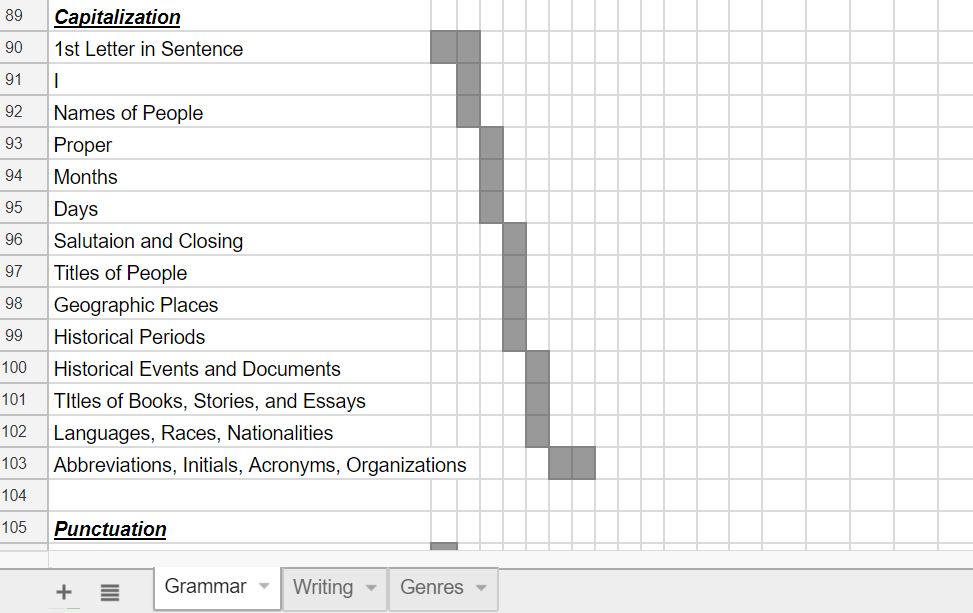
Basically, I took the TEKS and broke them down into a K-12 list so I could easily see what grade taught which expectations. I also wanted kids to see that capitalizing the first letter in a sentence was a KINDERGARTEN and FIRST GRADE TEK. Not sure the irritation comes through correctly here, but I'm sure that anyone who's graded a paper in the last century would understand.
Now, I really don't believe in shaming kids, but I do believe that we should let them know what they should be able to accomplish. We don't let kids go around pronouncing "spaghetti" as "pasgetti" because babytalk is embarrassing. Neglecting basic mechanics is written babytalk and is even more embarrassing. At least it should be.
So how can you use the chart?
1. Reference. It's an easy way to look at what is supposed to be learned before the kids get to you and to have a clear understanding of where kids are headed.
2. Give pieces of it to kids. Once you cover something in class, then you can have the kids highlight it as a non-negotiable editing item. Or you could have kids show you EVIDENCE that they can apply these skills in their writing.
Hope it helps.
Tuesday, October 24, 2017
Classroom Application of Round Table Editing
Kambria Witschi from Higgins ISD created this assignment to use with her students during a Round Table Editing session. Perhaps you could use it as well?
Round
Table Editing
After
each phase, give students class time to make corrections before moving on to
the next step.
Phase 1: Basic Edits
Allow 5 minutes per step. First, students are to READ the essay and
THEN edit.
1.
* by the hook sentence
2.
Underline thesis
3.
Highlight the 3 reasons in body paragraphs
4.
Box the explanations of reasoning
5.
Intro basic editing (spelling, grammar,
punctuation, wording)
6.
1st body paragraph basic editing
7.
2nd body paragraph basic editing
8.
3rd body paragraph basic editing
9.
Conclusion basic editing
Phase 2: Make necessary corrections
Phase 3: Hard Edits –
Allow 10 minutes per step for
students to edit the whole essay. First,
students are to READ the essay and THEN edit.
1.
redundancies/repeated reasoning
2.
gaps in logic: places where more explanation is
needed
3.
Opinions
4.
Irrational/incorrect information
5.
Organization: moving around paragraphs, reworking,
or eliminating parts of text
·
Introduction
·
1st body paragraph
·
2nd body paragraph
·
3rd body paragraph
·
Conclusion
Phase 4: Make necessary corrections
for final draft
Monday, October 23, 2017
It's not your job to teach Romeo and Juliet
Are you mad yet? Hope so. People think that I mean that they shouldn't teach Romeo and Juliet. Not true. I love the classics. Friday, I worked with an amazing group of teachers. As we were working through the drama unit, I think I finally communicated what I have been trying to say for years. Maybe.
English I TEKS ask us to:
Understand how dramatic conventions like monologues, soliloquies, and dramatic irony enhance dramatic text.
But we can't STOP there.
Next, we must make inferences and conclusions about how these dramatic conventions enhance the dramatic text.
But what does that mean?
Here's the monologues in the play.
Our "job" here is to teach kids how to comprehend and analyze the dramatic conventions for themselves. This means that we need to model how one accomplishes that. In most classrooms that I have observed, teachers have students play the roles of the characters and the class reads the play aloud. As the play is read, teachers stop the reading to ask questions about what is going on - comprehension. And I have never seen that instruction help kids understand how to apply that knowledge to reading another play. Theoretically, teaching someone to read R and J should empower them to read any Shakespearean text. Sure, some of the questions on the quiz will ask kids to demonstrate comprehension of the text. Some quizzes also might ask kids to analyze the impact of the monologue. But at that point, it's all about RECALL! We still don't know if kids can read and analyze a play by themselves. What a waste of time.
That approach only makes sense as a first step. Here's the first monologue in the play. I need to pause and understand what is going on here, don't you? It's important for kids to understand that Juliet is overthinking things and questioning herself - like we all do when we fall in love. It's important for kids to understand the insecurity that is part of the human condition. It's important that kids recognize the situational irony that Romeo can hear what Juliet is saying.
But our TEK does not ask us to paraphrase the text to prove that we can translate Shakespearean poetry into modern day language. Our TEK does not ask us to even interpret Juliet's speech in terms of the human condition, situational irony, or realize the connection to our own experiences of insecurity in love. Which is important too. We just can't stop there. Which is what I think most lessons and approaches do.
Our TEK asks us to examine why Shakespeare chose to have Juliet speak in a monologue to advance his message in the whole play. Our TEK asks us to analyze purpose, author's message, and craft in advancing the plot by using a monologue to do so.
This kind of analysis asks us to examine something more than just tracking the plot. We first begin by thinking of the audience...just like Shakespeare did. He had to think about the audience's experience...how he was going to take them by the hand to lead them through to the surprise he had planned for them in the end.
Why did Shakespeare think that the audience needed to hear what Juliet was thinking? Most young women don't go to their windows and speak aloud to the night air. They ruminate and roll their thoughts around in their heads until they are half crazy. Shakespeare needed the audience to know Juliet's thought processes and frame of mind. In plays, playwrights use the tool of a monologue to get that job done. (In other genres, the narrator - usually first person or omniscient - explain character sentiments, plans, reactions, ideas, etc.) This monologue is how Shakespeare helped the audience prepare for what was coming next.
Here are some other ways to ask questions about the use of monologue:
Why did Shakespeare choose to have it said in a monologue?
What was the purpose of the monologue in the scope of the plot? Character development?
How does the monologue connect to the whole theme, purpose, or message of the play?
Why was it said that way - as a monologue? How would the theme, purpose, plot, character development, purpose have changed if the speech were an aside or a soliloquy?
What text evidence helps us know the answers to these questions?
Our job is not to help students understand the plot of Romeo and Juliet. It's much, much more.
If we are to teach students to critically analyze and actually teach what our curriculum dictates, lessons will not have some kids reading the text aloud while the rest of the class pretends to listen and waits for the teacher to stop and ask questions so that the rest of the class can then know what's going on. That's the equivalent of leading a bull by the nose. Students are not mindless cattle incapable of leading themselves.
Instead, the lesson would look like this:
1. The teacher would read the monologue aloud and show how he uses the text and research to figure out what the character is actually saying. (I don't think we are teaching how do do this either. We just ask questions to lead kids by the nose through the text. We have to actually teach people how to figure this stuff out. You can't just ask leading questions. People don't know what they don't know. You have to show them where to go to figure it out. You have to show them what to look for: No Fear Shakespeare for modern language translations "mayst think my havior light", looking up proper nouns: "They say Jove laughs", and obscure cultural references "I should have been more strange", etc.)
2. The teacher would then conduct a think aloud to show how he uses the dramatic choices made by Shakespeare to help make deeper interpretations and connections about the play and enhancements to the text overall.
3. Next, the whole class would need to examine another monologue to practice the skills the teacher demonstrated in the read aloud and the think aloud. A Shared Reading technique is useful for a whole group discussion. The teacher helps pose the questions, while the students work through the answers. (This could be done with another Shakespearean monologue in R and J, another Shakespearean play, or even another whole class text.) The teacher would go back to read aloud/think aloud as necessary to describe the correct text references and thinking protocols.
4. Following the gradual release model, students would then be ready to practice the cognitive analysis skills in small groups. The next monologue in R and J is also by Juliet. Students could then be divided in to small groups to read the monologue, build comprehension, and practice analyzing it's use in the play. The teacher could then have small groups meet with other small groups or bring the class back together for a whole class debrief.
5. The teacher then might conduct a comparative discussion about these three monologues. Were they all used similarly? How were they different? What impact does each have in the development of the plot? Why does Juliet have more monologues than any other character?
6. The next monologues in the play are completed by Friar Lawrence, Mercutio, the Nurse, and Romeo. Since this concept - of truly teaching this TEK past basic comprehension - I would recommend further group work. Each group could take on a different monologue and present the findings to the whole class. During their presentations, the rest of the class would be using a listening guide or note-taking analysis form to evaluate the strength of the interpretations. A whole class debrief of the presentation and evaluations by the audience would come next. Note- the class is taking on the analysis and evaluation of the group's interpretations, not the teacher.
7. Students would then be ready to apply this skill independently in another Shakespearean play or another contemporary/cultural play. (Remember that our TEKS ask us to examine plays from ALL time periods and cultures. Not just the English Cannon for WASPS.) The http://stageagent.com/ website that I have been using has recommendations for other plays that actors could use as audition pieces that might reveal some good choices for students to analyze independently. I wrote about some other common choices in a previous post if you need other sources.
8. Now we are ready to connect the skill to writing. Students could enter a piece of their own writing or a narrative text and compose an original monologue, adding a reflection piece about why they chose to adapt that text into a monologue and how it advanced or changed the plot, character development, or message of the text.
English I TEKS ask us to:
Understand how dramatic conventions like monologues, soliloquies, and dramatic irony enhance dramatic text.
But we can't STOP there.
Next, we must make inferences and conclusions about how these dramatic conventions enhance the dramatic text.
But what does that mean?
Here's the monologues in the play.
Our "job" here is to teach kids how to comprehend and analyze the dramatic conventions for themselves. This means that we need to model how one accomplishes that. In most classrooms that I have observed, teachers have students play the roles of the characters and the class reads the play aloud. As the play is read, teachers stop the reading to ask questions about what is going on - comprehension. And I have never seen that instruction help kids understand how to apply that knowledge to reading another play. Theoretically, teaching someone to read R and J should empower them to read any Shakespearean text. Sure, some of the questions on the quiz will ask kids to demonstrate comprehension of the text. Some quizzes also might ask kids to analyze the impact of the monologue. But at that point, it's all about RECALL! We still don't know if kids can read and analyze a play by themselves. What a waste of time.
That approach only makes sense as a first step. Here's the first monologue in the play. I need to pause and understand what is going on here, don't you? It's important for kids to understand that Juliet is overthinking things and questioning herself - like we all do when we fall in love. It's important for kids to understand the insecurity that is part of the human condition. It's important that kids recognize the situational irony that Romeo can hear what Juliet is saying.
But our TEK does not ask us to paraphrase the text to prove that we can translate Shakespearean poetry into modern day language. Our TEK does not ask us to even interpret Juliet's speech in terms of the human condition, situational irony, or realize the connection to our own experiences of insecurity in love. Which is important too. We just can't stop there. Which is what I think most lessons and approaches do.
Our TEK asks us to examine why Shakespeare chose to have Juliet speak in a monologue to advance his message in the whole play. Our TEK asks us to analyze purpose, author's message, and craft in advancing the plot by using a monologue to do so.
This kind of analysis asks us to examine something more than just tracking the plot. We first begin by thinking of the audience...just like Shakespeare did. He had to think about the audience's experience...how he was going to take them by the hand to lead them through to the surprise he had planned for them in the end.
Why did Shakespeare think that the audience needed to hear what Juliet was thinking? Most young women don't go to their windows and speak aloud to the night air. They ruminate and roll their thoughts around in their heads until they are half crazy. Shakespeare needed the audience to know Juliet's thought processes and frame of mind. In plays, playwrights use the tool of a monologue to get that job done. (In other genres, the narrator - usually first person or omniscient - explain character sentiments, plans, reactions, ideas, etc.) This monologue is how Shakespeare helped the audience prepare for what was coming next.
Here are some other ways to ask questions about the use of monologue:
Why did Shakespeare choose to have it said in a monologue?
What was the purpose of the monologue in the scope of the plot? Character development?
How does the monologue connect to the whole theme, purpose, or message of the play?
Why was it said that way - as a monologue? How would the theme, purpose, plot, character development, purpose have changed if the speech were an aside or a soliloquy?
What text evidence helps us know the answers to these questions?
Our job is not to help students understand the plot of Romeo and Juliet. It's much, much more.
If we are to teach students to critically analyze and actually teach what our curriculum dictates, lessons will not have some kids reading the text aloud while the rest of the class pretends to listen and waits for the teacher to stop and ask questions so that the rest of the class can then know what's going on. That's the equivalent of leading a bull by the nose. Students are not mindless cattle incapable of leading themselves.
Instead, the lesson would look like this:
1. The teacher would read the monologue aloud and show how he uses the text and research to figure out what the character is actually saying. (I don't think we are teaching how do do this either. We just ask questions to lead kids by the nose through the text. We have to actually teach people how to figure this stuff out. You can't just ask leading questions. People don't know what they don't know. You have to show them where to go to figure it out. You have to show them what to look for: No Fear Shakespeare for modern language translations "mayst think my havior light", looking up proper nouns: "They say Jove laughs", and obscure cultural references "I should have been more strange", etc.)
2. The teacher would then conduct a think aloud to show how he uses the dramatic choices made by Shakespeare to help make deeper interpretations and connections about the play and enhancements to the text overall.
3. Next, the whole class would need to examine another monologue to practice the skills the teacher demonstrated in the read aloud and the think aloud. A Shared Reading technique is useful for a whole group discussion. The teacher helps pose the questions, while the students work through the answers. (This could be done with another Shakespearean monologue in R and J, another Shakespearean play, or even another whole class text.) The teacher would go back to read aloud/think aloud as necessary to describe the correct text references and thinking protocols.
4. Following the gradual release model, students would then be ready to practice the cognitive analysis skills in small groups. The next monologue in R and J is also by Juliet. Students could then be divided in to small groups to read the monologue, build comprehension, and practice analyzing it's use in the play. The teacher could then have small groups meet with other small groups or bring the class back together for a whole class debrief.
5. The teacher then might conduct a comparative discussion about these three monologues. Were they all used similarly? How were they different? What impact does each have in the development of the plot? Why does Juliet have more monologues than any other character?
6. The next monologues in the play are completed by Friar Lawrence, Mercutio, the Nurse, and Romeo. Since this concept - of truly teaching this TEK past basic comprehension - I would recommend further group work. Each group could take on a different monologue and present the findings to the whole class. During their presentations, the rest of the class would be using a listening guide or note-taking analysis form to evaluate the strength of the interpretations. A whole class debrief of the presentation and evaluations by the audience would come next. Note- the class is taking on the analysis and evaluation of the group's interpretations, not the teacher.
7. Students would then be ready to apply this skill independently in another Shakespearean play or another contemporary/cultural play. (Remember that our TEKS ask us to examine plays from ALL time periods and cultures. Not just the English Cannon for WASPS.) The http://stageagent.com/ website that I have been using has recommendations for other plays that actors could use as audition pieces that might reveal some good choices for students to analyze independently. I wrote about some other common choices in a previous post if you need other sources.
8. Now we are ready to connect the skill to writing. Students could enter a piece of their own writing or a narrative text and compose an original monologue, adding a reflection piece about why they chose to adapt that text into a monologue and how it advanced or changed the plot, character development, or message of the text.
Thursday, October 19, 2017
STAAR: You can't just look at the paragraph, people.
I'm geeking out over item analysis reports again. Once again, there is a pattern in why kids are missing answers. If we are going to help kids pass STAAR...If we are going to help kids understand the whole point of what people are trying to say...
We MUST analyze why they are making the decisions they are making with their incorrect choices. This analysis provides a window into how students are thinking about the text. The analysis reveals their thinking process. When we know the mistakes they are making in their thinking processes, we can accurately pinpoint instructional remedies and guide students to more effective reading processes.
Here's a classic example of what many of our students are thinking:
29: Analyze informational texts, author’s thesis/idea: The answer choices on this one are spread pretty evenly. It looks like the ones that did not know the answer were guessing with a slight preference for one : 10%, 21%, 15%
The stem asked kids to look at paragraph 14 to make an inference. If kids were only using paragraph 14, this question is confusing. There is not enough context in just that paragraph to answer correctly.
Though they owe their spread largely to the Internet, Little Free Libraries often serve as an antidote to a world of Kindle downloads and data-driven algorithms. The little wooden boxes are refreshingly physical—and human. When you open the door, serendipity (and your neighbors’ taste) dictates what you’ll find. The selection of 20 or so books could contain a Russian novel, a motorcycle repair manual, a Scandinavian cookbook, or a field guide to birds
29 From paragraph 14, the reader can infer that the author —
10% chose this one: A enjoys reading books by international authors - this comes from shallow reading and skimming. If you scan the text, you can see Russian and Scandinavian references. But that is not a correct inference about the author’s reading preferences. The author never discusses his reading preferences.
54% chose this answer: B appreciates the opportunity for discovery provided by Little Free Libraries Students who got this correct attended to the focus of the entire passage as well as the cues in the language indicated by the contrast of /though/ and /antidote/. These students combined the information in the first sentence of the paragraph with the rest of the supporting details in the rest of the passage. In addition, they considered how this paragraph was seated contextually inside the passage as a whole - they considered the author’s purpose and main message.
21% chose this answer C thinks e-books fail to offer the same variety of topics as printed books do Yes. The paragraph does mention a variety of books - /Russian novel/, /motorcycle repair manual/, /Scandinavian cookbook/, and /field guide to birds/. BUT, that was not the author’s main idea for including those examples. Students that chose this answer are not connecting their ideas to the main message of the entire text. They are not thinking about why those details are included in the passage. They are not reading for meaning.
D understands the limitations of Little Free Libraries There is data here in the passage that the little libraries have choices limited by the contributions of people who donate to the box. Students who chose this answer are not focusing on the purpose of including the the details about what is in the box. The purpose is not to focus on the limitations of the choices there but on the delight in such variety. The students who chose this answer missed the entire point of the passage. They did not understand the main idea/ thesis.
Wednesday, October 18, 2017
Socratic Seminar Resources and Lessons
Today, I met with some amazing teachers. We explored Socratic Seminars and then developed skeleton lesson plans.
Daniel Crites, Tiffany Crites, Tay Jack, Debbie Roberts, Teresa Snell, and Danna Trujillo created the lessons. They will be going back to their classrooms to implement the lessons and will have celebrations and refinements to share with us
Here is the join code to the google classroom for the training, links, and resources: 3ms4qod (If you would like to register in this course for 6 hour credit through Region 16, please contact me at shona.rose@esc16.net.)
Here is the link to access the lessons teachers created today.
Daniel Crites, Tiffany Crites, Tay Jack, Debbie Roberts, Teresa Snell, and Danna Trujillo created the lessons. They will be going back to their classrooms to implement the lessons and will have celebrations and refinements to share with us
Here is the join code to the google classroom for the training, links, and resources: 3ms4qod (If you would like to register in this course for 6 hour credit through Region 16, please contact me at shona.rose@esc16.net.)
Here is the link to access the lessons teachers created today.
Subscribe to:
Posts (Atom)