Friday, November 8, 2024
Ripe for Persecution? Momma, Love, and Christlikeness

Thursday, November 7, 2024
Sources for Teaching Revision: Student Writing and Teacher Modeling (You Can't Buy/Print That)
The Request:
She: Do you have ideas or a resource for revising? I've been recommending Grammar Keepers for editing but I'm not not sure how to help with revision. This is in elementary. And they have Patterns of Power.
Me: The sentence sections in Keepers are also effective for revision. But: the best source of revision is their own papers and ratiocination. There isn't anything out there you can buy. I mean - you can find practice stuff...but there's nothing really out there that tells you how to teach it.
So we talked back and forth for a while. We landed on a purpose, prompts, and source texts. And I found a lot of problems. And I swear, if someone tells me the answers are about diagramming sentences and knowing parts of speech, I'm gonna puke. Try diagramming some of the messes or naming the function and parts of speech that are posed as answer choices. Those old ways ain't gonna work or be a productive use of time. We have to go waaaay beyond naming grammar crap and 1)into how the grammar crap is used to convey meaning 2)and to name what causes the meaning to be obscure because of sentence construction 3)and the function of how words/parts of speech are used in the semantics, syntax, and overarching author's purpose and craft.
The Texts:
The Prompts:
I used a Chart of STAAR Prompts Grades 3-10 by Rene Jackson on Trail of Breadcrumbs to help craft prompts. It was important to generate prompts that used the right genres, correspondence, purposes, and the source texts meaningfully. Originally, students were going to write to experts of the texts to ask questions...but that wouldn't really have been a match to the TEKS. Great idea...worthy of doing. But not really preparation for what they will have to do on STAAR.
I also used CHAT GPT to make some prompts. It was important to write two kinds of prompts - one from the comprehension strand and one for author's purpose.
Comprehension: Write a letter to a friend explaining the importance of coral reefs. Describe what coral reefs are, their role in marine ecosystems, and the various species that live there. Share any interesting facts you learned from "Coral Reefs" by Erin Spencer, and explain why protecting coral reefs is crucial for the environment. (Chat GPT)
Author's Purpose: Examine the key characteristics of how the writers organized the information in x text. In a letter to your teacher, explain how the writers used these characteristics to effectively communicate their main points and make the text interesting to children. (me)
The Problems during the Process:
What I Sent Her
Lesson One: When sentences get it right
Lesson Two: Problems with order, pronouns, be verbs, and repetition
Lesson Three: Awkward order, subject placement, concepts, pronouns, be verbs, and general sentence messes
Problem Three: Awkward Order and repetition: In prose, we use subjects and then verbs. He just kept coming back. In poetry, we might say, coming back...he just kept coming back. The repetition serves a purpose and adds tension. But just kept doing is...well, weird. Doing what?
The Ending
Thursday, October 31, 2024
Linguists or Readers? Phonics Instruction Problems
 |
This is a GREAT assignment. Don't get the wrong picture. What we have to consider is the POINT of using the activity. And we have to consider the little people, the audience. /ed/ does say three sounds. And there is a reason. There are rules. All kinds of them. And all kinds of oddballs that don't follow rules. (Should I dress as an oddball for Halloween? Oh - I'd look like myself. Nevermind.) Teaching and Leaving Breadcrumbs:Gretchen Bernabei knows the importance of leaving breadcrumbs. So did Hansel and Gretel. But like Hansel and Gretel - we have to use something more permanent than bread. The cues have to remain so learners can use the ideas when we aren't there anymore. Here's a story to explain. I had a hard time with Algebra. Dutifully, I took notes. Wrote down all the teacher had chalked onto the dark green board at the front of the room. I could do a problem or two of the even numbers while I was in class. But when I got home, my notes were no help. I could no longer remember, hear, or see what had happened between the lines in the notes. And I didn't really understand what was happening on the lines in the notes. The instruction on the process was gone. And I was lost. There were no breadcrumbs for me to follow. And I couldn't look up the answers because only the odd ones had the answers in the back of the book. And I still wouldn't know how to get there. Many times, we are teaching the WHAT. But we leave out the why and the how. Teaching the Why and How: Point One about Phonics RulesA group of English I one experts helped draft an example of how they will help students with inferences, text evidence, and writing. The heart is our brainstorming for WHY we are teaching the lesson and WHY students should care. The details/means/matters chart is the WHAT, the answers for ELAR. The arrows below are the brainstorming for future questions and bullet items that will go on the anchor charts and modeling books. The reason that we knew to do this is that all of us were working with targeted students - observing them during the activity. We asked four questions:
H, the kid I was working with was having no trouble in reading the text or understanding it. But he was struggling about how to tell where his ideas went - "Does this go in the means or matters box?"  In the video at the end, I'll ineloquently. and in terrible handwriting, model the same kind of thing for the phonics lesson on /ed/ sounds. I'll post the video later...still rendering. Back to /ed/ Phonics ExampleSo, when teaching phonics lessons, the student I was working with struggled with how we discern the patterns in the words. They could divide the words into the right columns by sound - but they didn't know WHY the words HAD those sounds. So let's stop and think here for a moment...The student was successful with the phonics activity sort because they already knew how to say the words. Isn't the point of phonics to be able to decode the words? Erm...yes. The point of this activity is to help with critical thinking and analysis - to infer the pattern or rules that govern the sounds. It's not really phonics anymore. And...I was wrong about my hypothesis in the video. In looking at the sounds and letter patterns, I tried consonant and vowel patterns, short vs long patterns, and consonant pair patterns. Turns out that the rule is even more/less nuanced. The /ed/ says /t/ when the word is a verb that ends in consonant that has an unvoiced sound. See here for a more detailed explanation. Playing Out the Rule in Context: Point TwoSo let's imagine a kid is reading some words they don't know. Let's say it is even a list and not really reading a real book. twisted wished asked banged pressed Here's what they'd have to think: 1. Take off the ed. 2. Is the word a verb? Yes 3. Is the last sound of the verb an unvoiced sound? Yes - Say /t/ for the /ed/ sound 4. Is the last sound of the verb voiced? Yes - Say /d/ for the /ed/ sound 5. Is the last sound of the verb a d or a t? Yes - Say /ed/ or /id/ for the /ed/ sound. (Depending on your dialect, you say /id/ or /ed/. As if that's not already confusing enough.) And really. Is that sequence of thinking and questioning what we want kids to do when they are reading words or anything else? Did you even know or realize the three sounds and the rules that govern them? Did your teacher ever tell you that? Did you remember the rules if you did learn it at some point? No. If you did - you are a linguist. A scientist for language. 2nd Graders aren't Linguists |
Is there value in understanding patterns? Yes. But it's not singularly about reading words and comprehending.
Is there value in understanding and knowing rules. Yes. On the playground for most of them.
But when we are reading words like "wish," we are reading them in sentences and stories to make and use ideas. If the word is "wished," a kid is going to know that the text is probably a fairy tale from the context and genre characteristics. If they say /wishid/, then they are having a vocabulary problem not a phonics problem. And who cares if they say /wisht/ or /wishd/? The way the sounds come out in the mouth, the right thing will probably happen because of physiology or dialect. NOT because the kid knows the word ends in an unvoiced pattern.
Y'all. We need to really examine the purpose of our lessons: HOW we teach them and the impact of our actions.
Making /ed/ words about rules is about word calling. That's not READING. And it damages how kids think about what it means to read.
We should NOT be teaching linguistic science to little kids. We should be teaching them how to make meaning from and with the symbols as they appear in context and use.
Wednesday, October 23, 2024
Did I EARN it? What's next for service to literacy? The Vessel, Unity Learning Communities, and 12 Kids
It seems like a lot happens around the dinner table, coffee tables, and gatherings of folks.
The summer after third grade, I sat at the formica and chrome table to watch my mom teach my brother David how to read. The harvest gold refrigerator hummed nearby. The same one under which I used to hide my HILCOA vitamins.
By fifth grade, I was assigned a first grader to help learn to read. At the antique dining room table we bought from an estate sale from down the street, Mom helped me create manipulatives, handwriting paper, and flash cards from a book called Recipe for Reading. I still have the book...tattered and faded.
During college, I heard a sermon on Romans 1 after the Lord's Supper Table. Reprobate minds and stuff. I remember thinking about what this meant for reading and reasoning. As I pondered, all the ideas were the same ones we saw in Figure 19 many years later and all the things in the Comprehension Strand beginning in 2019. Comprehension became a lifetime obsession.
Doneice Ray allowed me to teach a first grade class as a long term sub when I graduated in '91. Wow. What an experience. Did I really know how to teach a person how to read? Did I even know about the Guided Reading table? Nope. The next semester, I was honored to teach for her in fifth grade. I stayed long enough to have those former first graders in my fifth grade class. By that time, I was figuring out a few things.
Thirty three years later sitting at the granite bartop next to stainless steel appliances that don't last 10 years, I'm still figuring things out and the search continues for supporting comprehension in all readers and thinkers.
Since retirement...I've been struggling. There's this scene at the end of Saving Private Ryan that summarizes my thoughts. Have I been and done what I've been gifted and charged to be? Have I earned it?
And then this summer... Tremaine Brown, Jacob Breeden, and I put our heads together on a project over a piece of brown butcher paper in the dining room at Shi Lee's Soul Food. You see, Tremaine tries to make The Heights a better place for his daughter and all those around him. He's fed people so their tables and tummies are full. He's made sure they have clothes. He makes sure they have school supplies. He makes sure they have fun at holidays. But how could he help them with literacy? And we all know that success in school is complicated. Lots of reasons kids and teachers struggle. With the Vessel and Unity Learning Communities, we want to tackle all the barriers to literacy.
In January, we'll begin with 12 kids. 5th and 6th graders that struggle with reading and writing. A counselor will lead a group of four teachers - three kids per adult. And a "grandma" figure will be the mentor for all of them. The community at the Warford will partner with us.
As students of AISD, they've had all the literacy interventions. Powerful initial instruction and remediation. But yet, there are those that still struggle and aren't qualified for services like special education or emerging bilingual support. And there are those that have struggles related to society and living life in this century. We'll dig into those issues together, solving and supporting the struggles together.
Honestly, it's a giant experiment. The Amarillo Area Foundation has funded a portion of what we need to begin...and we are honored by their investment in our children's future. This month and the next, we are meeting with teachers and counselors to collaborate on a set of challenges, processes, and key vocabulary and theoretical underpinnings for our approach. In January, we'll begin meeting with kids...thought partners and co-creators with them to cause their own success and growth.
Along the way, we'll all be writing and documenting the process and outcomes...telling the story of what happens around these new tables. Won't you join us? Learn more, connect, and join us here: https://www.beblessedbythevessel.org/home
(AI) Machine Scoring isn't the Problem: We are ALL Writing for Bots
I've been meaning to write about this for a while. But by now, many people have seen the scores and papers on STAAR exams. Very few essays have needed rescoring. Everything is going to be ok for both content scoring and mechanics. The scoring machine isn't the problem. Instructional relevance is.
Yes - there are many things we still don't know about the language models used and how machine scoring actually works. That IS a problem but one of transparency from the agency, not for instructional implications.
So let's think about how we can USE scoring realities to help make the process meaningful to those we serve. Here are five points that explain why we directly teach why machine scoring is relevant to daily life:
1. All social media works with algorithms. You want to be seen and heard? You use terms and structures that the algorithm values. The scoring machine is looking for key terms from the text and prompt.
2. Things like Netflix and Youtube give you content based on your behaviors. What you do changes what you are presented. You want to understand how to do the same for readers - even machines? Learn how to respond to reader needs with your text.
3. Search engines work on what is promoted and searched and clicked frequently. Want a high score? Write what the rubric promotes and seeks. Want a high score? Use what's in the source text that fits the prompt. Scoring works like a giant Family Feud. Other students have already responded to this prompt with the source text and answer. The scoring machine "surveyed" a BUNCH of student essays and knows what most writers said and how the people scored their responses. Comprehend the text and the prompt. Use the text stuff in the written response, summarize how it fits into the text, and say in original thoughts about the connection to the ideas in the prompt.
4. Search engines use key words to scan content and then matches those terms relevant to user's search terms. Want to be "seen" by the engine? Use terms that match what people want to see. For example, I've been writing for Sirius Education Solutions about thinking and reasoning in a project called Page to Pixel. There's a guy who reads over my stuff, restructures WHERE certain terms appear in the text, adds terms throughout, and chooses special search terms to embed in the code. I have no idea how the code works, but I can see that the key stuff goes in the intro, key connections to the topic are spread in each portion of the headings and body text, and the key stuff also goes into the conclusion. Sound familiar? We trace meaning and coherence through word choice and how we connect our topics through organizational structure. So, want a high score? Use key terms from the prompt and text in the intro and conclusion. Thread those ideas through each body paragraph with text that shares the same ideas/synonyms/textual context. The guy who edits my work for this puts these terms in bold so I can see how they thread through the text. I can see the connection and repetition of concepts through the entire text.
5. Companies use machine scoring to preview resumes, cover letters, and communications. Priorities are given to text that includes what the company is looking for in the match of personnel to the job description and company goals. Understanding machine scoring is intensely personal and relevant to all those who are seeking employment.
Machine scoring isn't new. Digital evaluation going on in the background of almost everything we do and see. And teaching without including explicit lessons on the relevance of these scoring machines isn't in the TEKS, but we'd be remiss if we didn't address the reality directly.
Wednesday, August 21, 2024
Sources...Bias...Decision Making: A Reader's International Moral Imperative
Well. This might make some folks mad. But it's not political even though both sources come from opposite sides of the political arena.
But it's absolutely the kind of thing we need to be paying attention to.
The obvious: no one wants Monkey Pox. Ew.
Here's Source One: https://www.breitbart.com/politics/2024/08/21/w-h-o-declares-monkeypox-a-global-crisis-heres-whats-really-going-on/
Here's Source Two: https://www.nytimes.com/2024/08/14/health/mpox-who-emergency-africa.html
Questions to ask up front:
- What kinds of things does the site discuss?
- Who is behind or writing the article?
- What is their general stance on ideas?
- Who is sponsoring the content? How is the sponsor benefitting from the article or association with the author?
- Examine the title for loaded words and bias: Note the subtext after the colon in the title of the first article "Here's What's Really Going On." It hints at public deception at the worst and public ignorance at the least.
- Examine sponsorship and ad placements: The first article is sponsored by "The Wellness Company." The video story thumbnail begins with a picture of the kit the company sells. Toward the end of the article, there is a large colored ad about the kit. The last paragraphs of the article discuss how to "thwart the plan" (to make you sick?) and that you are a fool if "hope" is your "strategy." Links are then given to provide a better strategy by buying the wellness kid. And at the end, the article concludes with a linked call to action to purchase the kit. Calls to action = persuasion. Commercials.
- Examine citations and references: There are no citations or references to where we can find the data reported in the article. Note, there are hyperlinks that take you to a paper. And the steps for evaluating the source are critical here as well. Note that citations and references must also be validated for reliability, validity, and credibility. Note that the executive summary clipped into the article is on page 8 of the brief. But also note the end of pages 2 and 5. And note the language in the beginning of the article...it's an argumentative text - which changes how you read it. It's not purely informational.
- Examine how other titles are referenced and when they change. The way the text is presented, the following text seems that it came from the NYT. But the article has only copied the font and headline with the introduction to the article and followed with their own text. An honest representation would have made this a different kind of graphic feature like a picture with a caption. The way it appears is misleading and an example of poor scholarship and attribution.
- Examine links and referenced texts. Seek the original source. Note that the NTI paper references a "fictional scenario" that "unfolded in a series of short news videos that participants reacted to," (page 10). Note who the participants were on page nine. The article is about a roundtable discussions on a fictional scenario of a monkeypox outbreak and the suggestions for dealing with such an issue. Their findings aren't necessarily bad...but the way the data is used doesn't exactly match the original purpose.
- Note the stuff at the bottom about how comments are used. Facebook. Algorithms driving folks to the site = more hype and more clicks for the advertiser. (I'm being biased here because I'm irritated.)

Monday, August 19, 2024
Teaching from Zeros (A): When the thesis doesn't match the evidence
Kernels: Organizational Structure
Use colors to code the organizational structure and components.
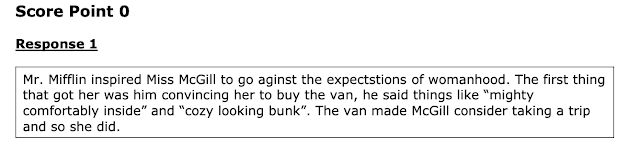
Mr. Mifflin inspired Miss McGill to go aginst the expectstions of womanhood. The first thing that got her was him convincing her to buy the van, he said things like "might comfortably inside" and "cozy looking bunk". The van made McGill consider takinga trip and so she did.
Introduction: Answer: Mr. Mifflin inspired Miss McGill to go aginst the expectstions of womanhood.
Body: Example: The first thing that go her was him convincing her to buy the van, (runon sentence)
Body: Text evidence: he said things like "mighty comfortably inside" and "cody looking bunk". (second half of runon sentence)
Body: Explanation: The van made McGill consider taking a trip and so she did. (runon sentence)
Conclusion: Missing
Evaluating Accuracy: Thesis:
"going aginst the expectstions of womanhood" is a correct interpretation.
Evaluating Accuracy: Evidence:
"comfortably inside" and "cozy looking bunk." are both pieces of evidence that are significant to Miss McGill's revelations. But they are not about the same topic the writer has chosen for the thesis. The evidence is about comfort and not about going against what women are supposed to do. The generalization about the text evidence (comfort) must match the thesis (going against) - which this one doesn't.
Evaluating Accuracy: Explanation:
Does the explanation match the thesis, the generalization using the evidence, the people, and the focus of the topics in the prompt? You have to evaluate the sentence for each component.
The writer says "the van" made McGill think differently. The prompt tells us that we are supposed to think about the interactions with the seller, Mr. Mifflin. The van made Mc Gill consider taking a trip and so she did. We are supposed to be talking about the impact of talking to the seller, not the impact of the qualities of the van.
The writer says the significance of the revelation is to take a trip but is not related to how this goes against the expectations of women as stated in the thesis: The van made Mc Gill consider taking a trip and so she did.
There is nothing in the sentence that talks about how comfort mentioned in the text evidence is related to the thesis of going against expectations.
There is nothing in the sentence that mentions interactions with Mifflin.
Improving the content during revision:
Take the original text and add breaks for organizational structure and where pieces are missing or don't match.
Mr. Mifflin inspired Miss McGill to go aginst the expectstions of womanhood.
The first thing that got her was him convincing her to buy the van, he said things like "might comfortably inside" and "cozy looking bunk".
The van made McGill consider taking a trip and so she did.
Delete the stuff that is wrong.
Mr. Mifflin inspired Miss McGill to go aginst the expectstions of womanhood.
The first thing that got her was him convincing her to buy the van, he said things like "might comfortably inside" and "cozy looking bunk".
The van made McGill consider taking a trip and so she did.
Add and Replace: Make the match
Mr. Mifflin inspired Miss McGill to think of how comfortable the van would be and to go aginst the expectstions of womanhood.
The first thing that Mr. Mifflin said was him convincing her to buy the van because it was comforatble. He said things like "might comfortably inside" and "cozy looking bunk".
Mr Mifflin's positive comments made McGill consider taking a relaxing trip and so she did.
Add and Replace: Add the missing
Add a new topic sentence. Since we talked about this idea second, it will be the second paragraph. It's really a strong idea, so it's also good to end with a bang. The writer can flesh out the ideas for the first and second paragraphs with more text evidence and conclude with a statement that summarizes both points.
Mr. Mifflin inspired Miss McGill to think of how comfortable the van would be and to go aginst the expectstions of womanhood.
The first thing that Mr. Mifflin said was him convincing her to buy the van because it was comfortable. He said things like "might comfortably inside" and "cozy looking bunk". He was pointing out the positive elements of living in a small space like a van to make her believe it would be a pleasant experience. The writer shares additional details about the space that add to it's appeal as well. The author points out the "extra room for the bookshelves" that Miss McGill states later she will enjoy reading. As a matter of fact, the author points out that "Every possible inch of space seemed to be made useful in some way, for a shelf or a hook or a hanging cupboard or something. Above the stove was a neat little row of pots and dishes and cooking usefuls." This would appeal to a woman who was used to doing all the things for herself and others.
Mr Mifflin also encouraged Miss McGill to go against the expectations of womanhood. He says, "If you’re so afraid of your brother taking a fancy to her, why don’t you buy her yourself and go off on a lark? Make him stay home and mind the farm! . . . Tell you what I’ll do. I’ll start you on the road myself, come with you the first day and show you how it’s worked. You could have the time of your life in this thing, and give yourself a fine vacation. It would give your brother a good surprise, too. Why not?" She then realizes that she'd "been living on that farm for nearly fifteen years—yes, sir, ever since [she] was twenty-five—and hardly ever been away except for that trip to Boston once a year to go shopping with cousin Edie." This means that buying van gives her an opportunity to do what she'd never had the chance to do because she was a woman. She writes her brother a letter explaining that the "revolt of womanhood" was coming to Andrew's door because she wouldn't be there to bake his bread or do his laundry.
Mr Mifflin's positive comments made McGill consider taking a relaxing trip and so she did. She realized that taking this trip would be her own form of revolt against womanhood and "better than going to college."
Source:
https://tea.texas.gov/student-assessment/testing/staar/2024-staar-english-i-scoring-guide.pdf
And thanks to Gretchen Bernabei for Kernels.
Annotated DOC:
https://kami.app/VCx-fdw-QkC-aX4